Quick Answer: Wooden toys can give children repeated opportunities to practice the small, controlled hand and finger movements involved in fine motor skills. Activities such as stacking blocks, turning puzzle pieces, sorting shapes, and threading large pieces also bring hand-eye coordination into everyday play.
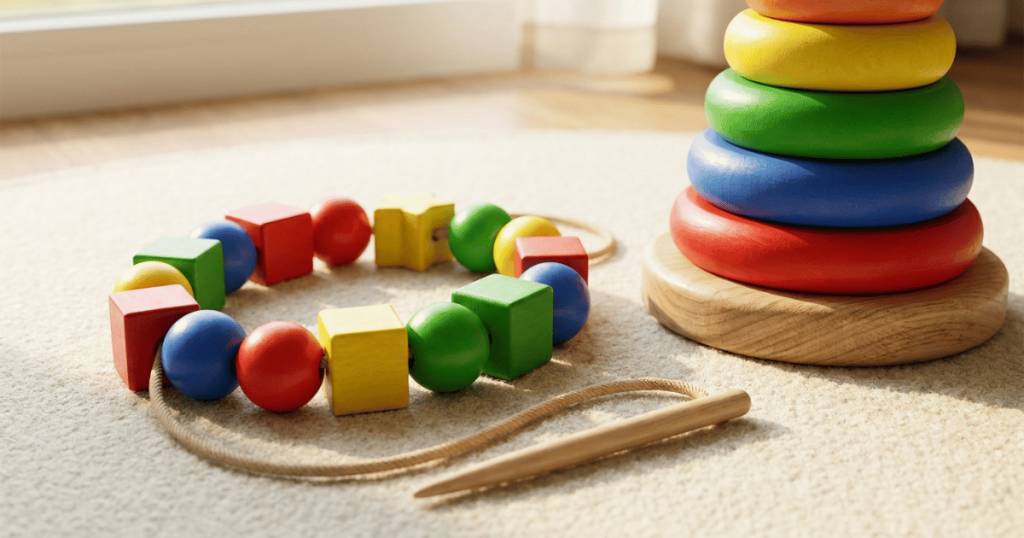
What Fine Motor Skills Actually Look Like During Play
Fine motor skills involve controlled movements of the hands, fingers, and wrists. Children use these movements constantly, often without us thinking of them as a “skill.”
Picking up a small object is one example. Turning a puzzle piece until it fits is another. Later, similar control is useful when children hold crayons, use a spoon, turn pages, pull up a zipper, or fasten a button.
The interesting part for parents is that practice rarely looks like practice.
A child sitting on the floor trying to balance one wooden block on another is concentrating on play. At the same time, the child has to pick up the block, control its position, judge where it should go, and release it without knocking everything over.
That combination of small movements is why simple hands-on toys can provide so many opportunities for fine motor practice. Early-years guidance also connects activities involving squeezing, pouring, spreading, and other controlled hand movements with fine motor and hand-eye coordination development.
Why Wooden Toys Can Work Well for Little Hands
There is nothing magical about wood that automatically improves a child’s fine motor skills.
The useful part is what the toy asks the child’s hands to do.
Many traditional wooden toys depend on physical manipulation rather than pressing a button and watching something happen. Blocks need to be picked up and positioned. Puzzle pieces have to be turned. Shapes need to be lined up with openings. Pegs may require a more precise grip.
These actions create natural repetition.
Wood also tends to give a toy some weight and a firm surface. In my experience, that can make certain pieces satisfying for small hands to handle, although the size and design of the toy matter much more than the material alone.
When my son was 3, he had a chunky wooden puzzle with a yellow duck piece that he regularly turned the wrong way before fitting it into place. After enough attempts, I noticed that he stopped using his whole hand to wrestle with it and began making smaller adjustments with his fingers.
Those tiny changes are easy to miss when we are waiting for a big milestone.
Different Toys Ask the Hands to Do Different Things
“Fine motor play” covers more than one movement. This is where looking beyond the toy’s educational label becomes useful.
Blocks and stacking toys
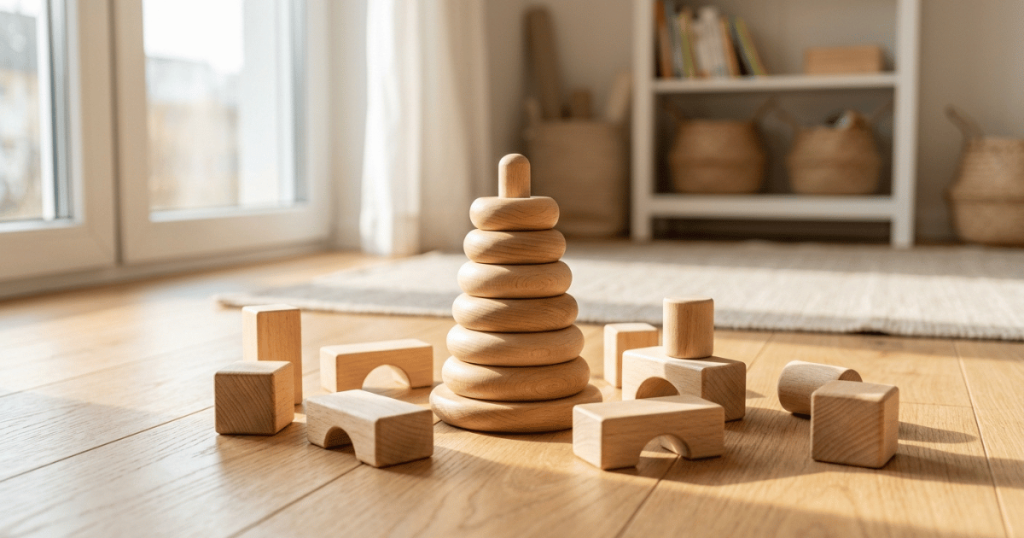
Picking up a block requires grasping and controlled release. Stacking adds careful positioning because the child has to let go at the right moment without upsetting the pieces underneath.
A younger child may begin by holding a chunky block in the whole hand.
As control improves, smaller objects can encourage more precise finger movements, provided the pieces are appropriate for the child’s age and safe for them to use.
Puzzles and shape sorters
Puzzles add another challenge because seeing the correct location is only part of the task. The hands still have to make it happen.
A child may pick up a piece, rotate it with the fingers or wrist, move it toward an opening, and adjust the angle. Research results on wooden-toy play repeatedly connect these activities with grip control, wrist movement, spatial awareness, and hand-eye coordination.
Shape sorters create a similar relationship between seeing and doing.
Pegs, threading, and lacing
Activities involving pegs or appropriately sized threading pieces can require more precise finger control.
One movement you may hear mentioned is the pincer grasp, which means holding something between the thumb and index finger. It is the kind of small, precise grip children gradually use for many everyday tasks.
Threading also asks both hands to cooperate. One hand may steady an object while the other guides the thread, which brings bilateral coordination, or using both sides of the body together, into the activity.
Fine Motor Skills and Hand-Eye Coordination Work Together
Fine motor skills and hand-eye coordination are closely connected, but they are not exactly the same thing.
Fine motor control is about making small, controlled movements with the hands and fingers. Hand-eye coordination involves using visual information to guide those movements.
Imagine a child putting a wooden circle onto a stacking post. The eyes help judge where the hole and post are, while the hands adjust the circle and lower it into position.
A puzzle works the same way.
The child sees an empty space, looks at the piece, decides how it might fit, and then tries to guide the hand accordingly. If the first attempt misses, the child gets another opportunity to adjust.
That small cycle of looking, moving, checking, and trying again is part of what makes hands-on play useful.
The Right Level of Difficulty Matters
A complicated toy does not automatically provide better fine motor practice.
Children need enough challenge to make an activity interesting, but they also need a realistic chance of succeeding. A toddler who is still learning to grasp and release may get more useful practice from chunky pieces than from a detailed puzzle requiring very precise finger control.
Watch what happens rather than focusing only on the age printed on the box.
Can your child pick up the pieces comfortably? Can they make an attempt without you physically doing most of the task? Do they return to the activity after getting something wrong?
My daughter once had a wooden bead activity that I brought out too early, and at around 3 she became annoyed every time the cord slipped out of the hole. I put it away for a while, and when we tried again later, she could guide the cord with much less help.
Sometimes changing the challenge is more useful than adding another toy.
Repetition Can Look Surprisingly Ordinary
Young children often repeat the same action far more times than an adult would find interesting.
They build a tower and knock it down. They empty the shape sorter, fill it, and empty it again. A puzzle they already know may still get completed repeatedly.
That repetition gives the hands more chances to perform familiar movements.
Progress may be subtle. A child might use less of the whole hand, rotate a piece with better control, drop fewer blocks, or need less assistance lining up a shape.
There does not need to be a formal practice session.
Research on fine motor play also emphasizes matching activities to the child’s current abilities and allowing repeated attempts rather than assuming that a more complicated activity produces better results.
Parents Do Not Have to Turn Play Into a Lesson
It can be tempting to correct every unsuccessful attempt, especially when you can immediately see how a puzzle piece should fit.
Waiting for a moment can be surprisingly useful.
If my child is working something out, I usually prefer to let the hands keep trying before stepping in. When frustration starts taking over, I might demonstrate one movement or make the task slightly easier rather than completing it for them.
For example, you can remove several puzzle pieces and leave only two choices. With blocks, you can start a short tower and let the child continue it.
The aim is to keep the activity playable.
Independent attempts, small amounts of help, and repeated opportunities can all exist in the same play session. Children do not need every movement explained to them for their hands to get practice.
Wooden Toys Are Only One Part of Fine Motor Play
Parents do not need a toy box full of specialized wooden toys to give children fine motor experiences.
Drawing, turning book pages, helping with simple food preparation, and handling everyday objects can involve many of the same kinds of movements. UK early-years guidance, for example, suggests everyday activities such as mixing, squeezing, pouring, and spreading as opportunities for fine motor and hand-eye coordination practice.
Wooden toys simply provide another playful way to create those opportunities.
This is also why I would be cautious about treating “Montessori,” “educational,” or “fine motor” on packaging as a guarantee of developmental value. Look at what your child actually has to do with the toy.
Does it invite grasping, turning, placing, stacking, matching, or controlled release?
That tells you more about the hand practice involved than a label does.
Safety still comes first. Pieces should be appropriate for the child’s age, and younger children need particular care around small parts that could present a choking hazard.
Most importantly, children develop at different rates. Play can provide useful opportunities for practice, but a wooden toy is not a way to diagnose or treat a developmental concern. If you are worried about your child’s development or notice a loss of previously acquired abilities, discuss it with an appropriate health professional.
Frequently Asked Questions
What toys help with fine motor skills?
Toys that encourage children to grasp, release, turn, stack, thread, fit, or position objects can provide fine motor practice. Wooden blocks, age-appropriate puzzles, shape sorters, and peg activities are common examples.
What Montessori toys are best for toddlers?
Simple, age-appropriate activities such as chunky puzzles, stacking toys, shape sorters, and posting activities are commonly associated with Montessori-style toddler play. The Montessori label matters less than choosing an activity your child can safely manipulate and repeat.
Do wooden toys improve hand-eye coordination?
They can provide opportunities to practice it. Activities such as fitting a puzzle piece, stacking a block, or placing a shape require children to use what they see to guide controlled hand movements.
Are wooden toys better than plastic toys for fine motor skills?
The material itself does not determine whether a toy provides useful fine motor practice. What matters more is the activity, including whether the child has to grasp, manipulate, position, and release objects at an appropriate level of difficulty.
When should children start fine motor play?
Fine motor development begins early through everyday handling and exploration rather than at one fixed starting age. Choose activities and toy pieces that match your child’s current abilities and age-related safety needs.