Quick Answer: The benefits of wooden toys for child development often come from the way children play with them. Simple wooden blocks, puzzles, stackers, and pretend-play pieces can encourage hands-on problem-solving, fine motor practice, sensory exploration, creativity, and independent play.
Why Simple Wooden Toys Can Create Richer Play
One thing I have noticed after years of buying toys for my own children is that the toys with the fewest instructions sometimes stay interesting the longest.
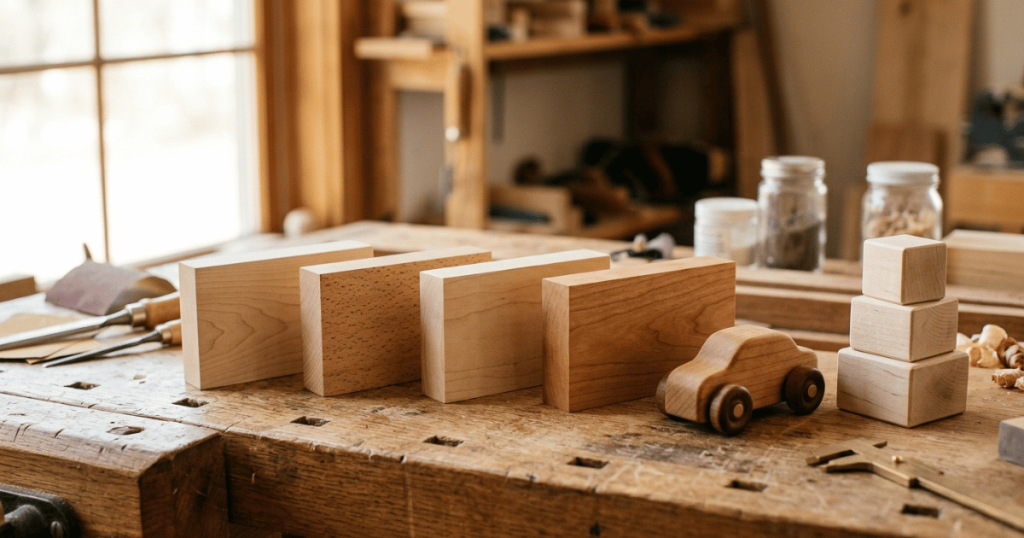
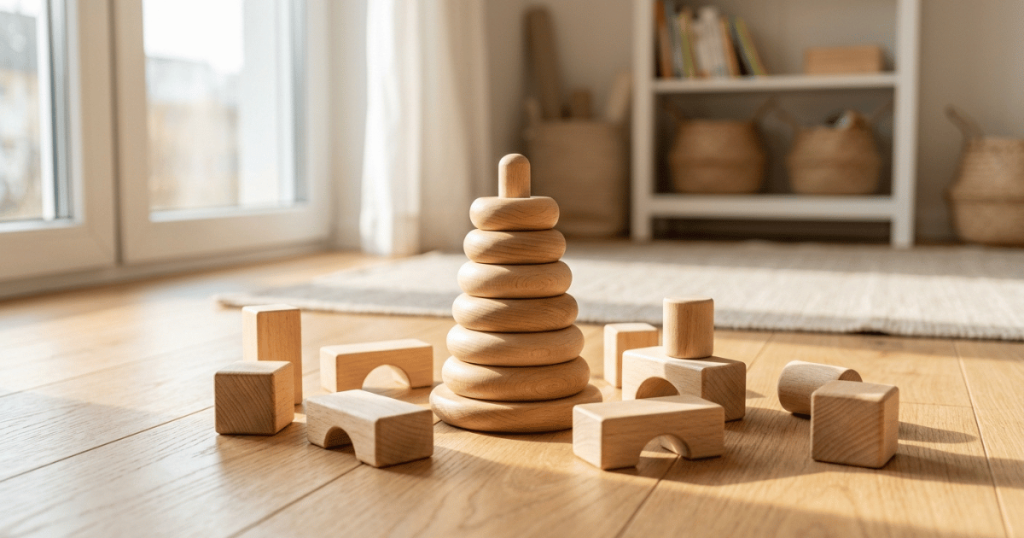
A wooden block does not tell a child what it is supposed to be. It can become part of a tower, a pretend sandwich, a bed for a tiny animal, or a bridge across the carpet. That flexibility gives the child more responsibility for creating the play.
This is usually what people mean by open-ended play. Instead of following one fixed sequence, children can change the rules, rebuild what they made, and give familiar objects new purposes. That naturally creates opportunities for creativity and problem-solving.
When my son was four, several rectangular wooden blocks that had spent the morning as a garage became “toast” for his toy kitchen that afternoon. Nothing about the blocks had changed. He had changed the idea.
That kind of imaginative flexibility is one of the qualities I value most in simple toys.
Wooden Toys Give Little Hands Real Work to Do
Fine motor skills involve the small movements of the hands and fingers that children gradually become more precise with as they grow.
Wooden toys can create plenty of reasons to practice those movements. A child may pick up a puzzle piece, turn it until it fits, balance one block on another, slide a bead, place a peg, or sort shapes into matching spaces.
These actions can also involve hand-eye coordination, because children have to connect what they see with what their hands are doing. When a piece does not fit, they adjust its position and try again. When a tower leans, they may move a block or start over.
The important part is the interaction, not simply the fact that the object is made from wood.
A beautifully made wooden toy that a child cannot manipulate or does not understand may offer less useful play than a simple age-appropriate toy made from another safe material. The design and challenge need to make sense for the child.
Problem-Solving Happens in Small Moments
We sometimes imagine cognitive development as something that requires a formal educational activity, but ordinary play can contain many small thinking problems.
Consider a basic set of blocks. A child learns that a wide block usually makes a steadier base than a narrow one. Put something heavy on one side and the structure may tip. Add another piece and the child has to decide where it can go.
Puzzles and shape sorters create different problems. A piece may look close to the right size but still refuse to fit until it is rotated. These little attempts give children opportunities to observe what happened, change their approach, and try again.
There is also cause and effect involved.
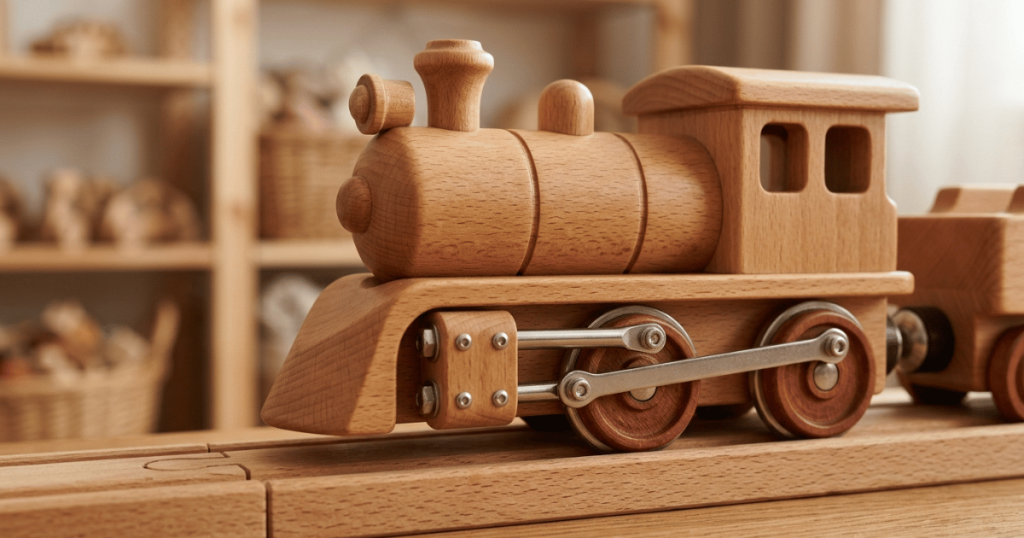
Push a wooden car and it rolls. Build too high and the tower falls. Place a round piece on a slope and it moves differently from a square block. Children can discover these relationships through their own actions rather than simply watching an effect happen automatically.
That does not mean every wooden toy automatically improves cognitive development. What matters is whether the toy gives the child something meaningful to explore, predict, change, or solve.
The Sensory Side of Wooden Play
Sensory play is another commonly discussed benefit of wooden toys, and it makes more sense when we look at what a child actually experiences.
Wood has a recognizable weight and firmness in the hand. Different pieces may have slightly different grain patterns, shapes, edges, and surfaces. Two blocks make a particular sound when tapped together, while a rolling wooden object gives different physical feedback from a soft fabric toy.
For younger children especially, touching and manipulating objects is part of discovering how the physical world works.
Weight can matter too. Children have to adjust how firmly they grip and lift objects of different sizes. A solid wooden piece may require a slightly different movement from a very lightweight object.
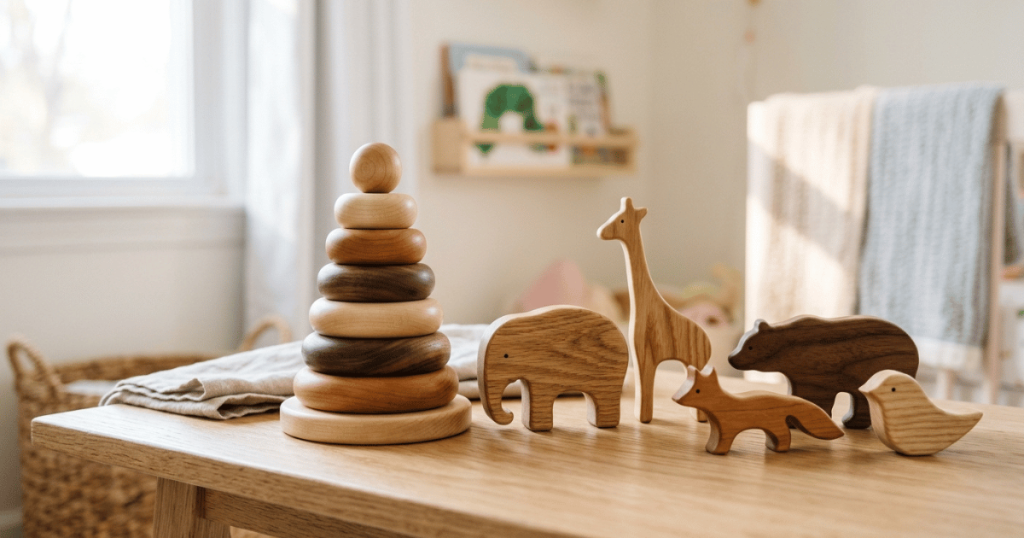
My daughter had a small wooden animal puzzle when she was about five, and I remember her running a finger around the curved elephant piece before turning it twice to find the correct position. The puzzle was simple, but her hands were doing much more than just putting an elephant into a hole.
Those small tactile experiences are part of why wooden toys can work well for sensory exploration.
Creativity Comes From What the Toy Leaves Unfinished
Some toys arrive with a clear character, storyline, sound, and expected sequence of actions. That can be fun, but there is less for the child to invent.
Many traditional wooden toys are simpler.
A set of plain figures does not decide who the characters are. Blocks do not decide what should be built. A wooden vehicle can travel to whichever imaginary destination a child creates.
This gives children room to practice symbolic play, where one object represents something else. A block becomes a phone. A wooden circle becomes a cookie. A row of pieces becomes a train carrying passengers across the living-room rug.
Pretend play can also encourage language. Children name characters, explain what is happening, negotiate roles with siblings or friends, and narrate their own stories.
The useful feature here is openness. Wood happens to be a material frequently used for toys with that kind of simple design.
Independent Play Can Build Persistence
A toy that responds immediately with lights or sounds can provide quick feedback. With a simple building toy or puzzle, the feedback often comes from the child’s own attempt.
The bridge stands or it falls.
The puzzle piece fits or it does not.
That creates opportunities to try again without an adult immediately correcting the child. Over time, children may experiment with several possibilities before asking for help.
As a parent, I have learned that stepping in too quickly can sometimes interrupt this process. When my son struggled to balance three blocks at age five, my first instinct was to straighten the bottom one for him, but he moved it himself after the tower fell twice.
Giving children a little room to struggle safely can make simple play more meaningful.
Social Skills Can Grow Around the Same Toys
Wooden toys are often discussed as tools for independent play, but many also work naturally with two or more children.
A shared set of blocks creates decisions. Who gets a certain piece? What are we building? Where should this block go?
Children may practice taking turns, sharing materials, explaining their ideas, and dealing with disagreements. Pretend-play pieces can create even more conversation as children assign characters and negotiate what happens next.
Parents can participate without controlling the game.
You might describe what your child is doing, ask one simple question, or add a character to a pretend scene. Then give the child space to decide where the story goes.
Wooden Does Not Automatically Mean Better
It is easy for discussions about the benefits of wooden toys for child development to turn into a wooden-versus-plastic argument. I do not think parents need that kind of pressure.
Children can learn through well-designed toys made from many materials.
A plastic toy can encourage creativity. Fabric toys can provide valuable sensory experiences. Art supplies, cardboard boxes, outdoor materials, books, and household objects can all become part of meaningful play when they are safe and appropriate.
The more useful question is what the child has to do with the toy.
Does the child manipulate it? Make decisions? Experiment? Imagine? Solve a problem? Can the toy be used in more than one way?
Those questions tell us more about developmental play than the material label alone.
Safety Still Comes Before Developmental Benefits
Natural material does not automatically make a toy safe.
Wooden toys should be appropriate for the child’s age and stage of development. For babies and young toddlers, small detachable pieces can present a choking hazard just as small parts from other toys can.
Parents should also look closely at the physical condition of the toy.
Check for cracks, splinters, loose components, damaged edges, and peeling or chipped finishes. If a painted or sealed toy is going into the hands of a child who still mouths objects, it is especially important to know that it was made for children’s use with an appropriate finish.
Weight deserves attention as well. Some solid wooden toys are surprisingly heavy for small hands, particularly large blocks and vehicles.
Regular inspection matters because wooden toys can last for years, but long-lasting does not mean maintenance-free.
Age Matters More Than the Wooden Label
A developmental toy works best when the challenge roughly matches what a child is ready to do.
A baby may be interested in grasping, holding, shaking, and exploring safe objects through the senses. As children gain more control of their hands, stacking and simple fitting activities can become interesting.
Later, puzzles, building pieces, pretend-play objects, and more complicated construction can offer new challenges.
The same wooden blocks can even change roles as a child grows. A younger child might stack three pieces. An older child might build a house, count the blocks, create a road system, or use them as props in a much larger imaginary game.
That ability to grow with a child’s ideas is one reason some simple toys remain useful for years.
Still, follow the manufacturer’s age guidance and consider your own child’s abilities. Children develop at different rates, and age labels also communicate important safety information.
Montessori, Wooden Toys, and a Common Mix-Up
Wooden toys and Montessori toys are often treated as though the terms mean the same thing, but they are not.
The Montessori approach is an educational philosophy with much more behind it than the material used to make an object. Many Montessori materials happen to use wood, and many modern toys borrow ideas such as simplicity, hands-on activity, and independent exploration.
A wooden toy is still simply a wooden toy unless it was specifically designed around particular educational principles.
For parents, the label matters less than the play opportunity. A straightforward stacking toy can be useful because your child has to observe, coordinate movements, experiment, and correct mistakes, whether or not the packaging uses the word “Montessori.”
Durability Can Give Children Time to Know a Toy
Developmental value is not always about introducing something new.
Children often return to familiar toys and use them differently as their skills and imagination change. A durable wooden toy can support that repetition because many well-made pieces tolerate years of ordinary play.
There is a practical benefit for families too. Toys that remain in usable condition can sometimes move from an older sibling to a younger one rather than being replaced quickly.
Durability can also reduce the feeling that children constantly need new entertainment.
A familiar set of blocks can present a completely new challenge when the child comes back to it with a new idea.
The Biggest Benefit May Be Active Play
After buying and playing with many different toys with my children, I would not choose a toy simply because it is wooden.
I look at what the child gets to do.
The strongest developmental value usually appears when children are active participants. They lift, arrange, test, imagine, sort, build, knock down, rebuild, and create their own rules.
Many wooden toys happen to be designed beautifully for that kind of play.
That is why the benefits of wooden toys for child development are better understood through the experience they create rather than through wood itself. A simple, safe, age-appropriate toy that leaves room for a child’s hands and imagination can become a surprisingly rich learning tool.
Frequently Asked Questions
Are wooden toys better than plastic toys?
Not automatically. Many wooden toys are excellent for open-ended, hands-on play, but safe and thoughtfully designed plastic toys can also support development. Look at what the toy allows your child to do rather than judging it only by its material.
What skills can children develop by playing with wooden toys?
Depending on the toy, children can practice fine motor skills, hand-eye coordination, problem-solving, spatial awareness, creativity, sensory exploration, language, and social skills. The benefits come from the actions involved in playing with the toy.
Do wooden toys improve fine motor skills?
Wooden puzzles, blocks, stackers, shape sorters, and similar toys can give children opportunities to grasp, rotate, position, balance, and fit objects. These repeated hand and finger movements can provide useful fine motor practice.
At what age can children start playing with wooden toys?
There is no single starting age for wooden toys because designs vary widely. Choose toys specifically intended for your child’s age, follow manufacturer guidance, and pay particular attention to small parts, weight, finishes, and the condition of the toy.
Are wooden toys safe for children to play with?
Well-made, age-appropriate wooden toys can be safe, but parents should still inspect them regularly. Watch for splinters, cracks, loose or small parts, damaged paint or finishes, and any other wear that could create a hazard.