Quick Answer: Wooden toys can create useful opportunities for language and cognitive development when children manipulate objects, solve problems, invent stories, and play with other people. The strongest benefit comes from what children do during play, especially talking, imagining, remembering, planning, and trying different solutions, rather than from wood itself.
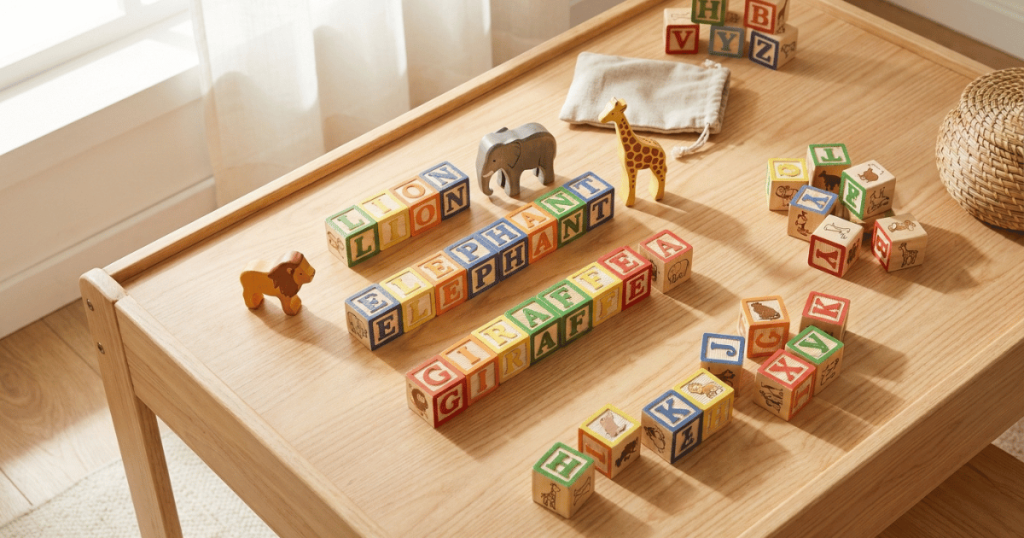
The Developmental Value Is in the Play
It is easy to see a wooden puzzle or block set labeled “educational” and assume the material itself is doing something special for a child’s brain. In everyday family life, I think it is more useful to look at the activity the toy creates.
A set of blocks does very little while sitting in a basket.
Once a child starts building, however, several things can happen at once. They decide where pieces should go, remember what they were trying to make, notice when a structure becomes unstable, and change their plan after it falls.
Add another person and language enters naturally. Someone asks for the long block. A child explains that the blue block is a bridge. A parent wonders aloud where the wooden car should go next.
Research and educational discussions around wooden toys repeatedly connect open-ended play with areas such as problem-solving, spatial thinking, creativity, language, and social-emotional experiences.
For parents, that distinction matters. We do not need to expect a wooden toy to “teach” by itself. We can pay attention to the opportunities for thinking and communication that happen around it.
Simple Toys Can Give Children More Decisions to Make
Some of the wooden toys that have lasted longest in our house have also been the least complicated.
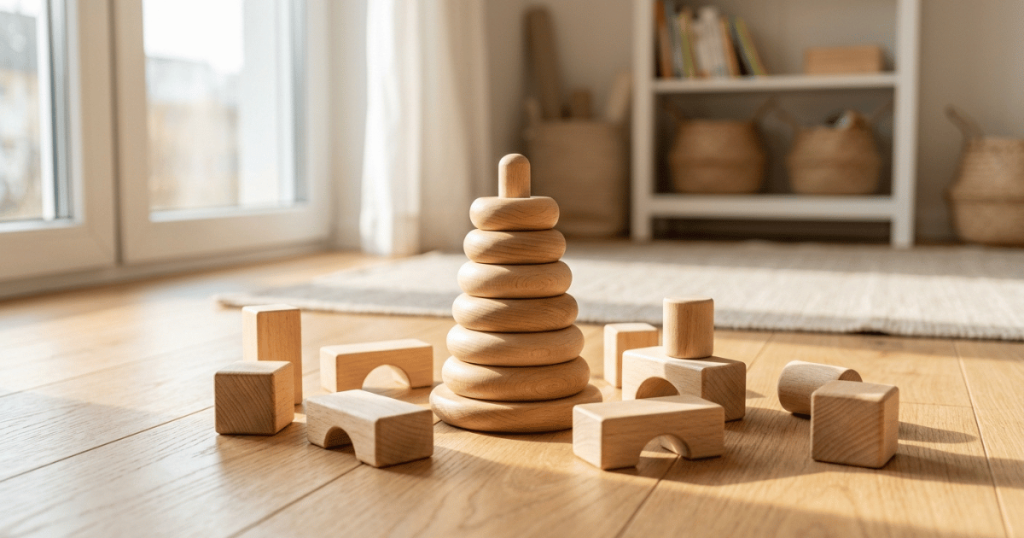
A plain block does not tell a child what it has to be. It might become part of a tower, a pretend slice of cake, a bed for a small figure, or a phone during an imaginary conversation.
Each change asks the child to supply the meaning.
That kind of open-ended play can involve planning and flexible thinking. If the first idea does not work, the child can rearrange the pieces or abandon the original plan and create something completely different.
When my son was 4, he lined up six rectangular wooden blocks across the carpet and announced that they were a train taking his little brown bear to the beach. Ten minutes later, those same blocks had become the walls of the bear’s house.
Nothing about the blocks changed. His idea did.
That flexibility is one reason I pay attention to how much a toy decides for the child. A toy with one fixed outcome can still be enjoyable, but an open-ended object can leave more room for the child to invent the problem and the solution.
Language Grows Around Shared Attention
A wooden toy cannot have a conversation with a child.
People can.
This is one of the most useful ways to think about wooden toys and language development. The toy gives you and your child something concrete to notice together, and conversation can grow around whatever is happening.
If your child picks up a wooden cow, you can name it. When the cow falls from a block tower, you can talk about what happened. During pretend play, the cow might be hungry, sleepy, lost, loud, frightened, or looking for another animal.
One object can create many reasons to use words.
Current language-focused wooden-toy content also emphasizes back-and-forth interaction, naming, storytelling, and turn-taking rather than simply exposing a child to spoken words.
Following the child’s attention can keep conversation natural
Parents do not have to quiz children throughout play.
If your child is concentrating on putting a red circle into a shape sorter, a simple comment such as “You’re turning the red one” fits naturally with what they are already doing. If they say “stuck,” you can respond to that word and the situation.
Pausing matters too.
Constant adult narration can leave little room for a child to respond. A short pause gives them an opportunity to make a sound, point, use a word, or show you what they want to happen next.
This keeps play feeling like play rather than a vocabulary test.
Pretend Play Turns Objects Into Ideas and Stories
Pretend play is especially interesting because children begin giving objects meanings that are not physically there.
A block becomes a bus. A wooden figure becomes a doctor. Two chairs and a few toy foods become a restaurant.
This kind of play can bring language and thinking together because the child has to hold an imaginary idea in mind while acting it out.
Researchers discussing educational wooden toys have also explored how toy figures, model objects, houses, and settings can connect imagined representations with language and meaning during preschool play.
The stories do not have to be elaborate.
A child might simply say that a wooden rabbit is going home. You can respond, “He’s going home. Who is waiting for him?” Now the child has a reason to extend the idea.
My daughter used to make a tiny wooden fox sleep underneath an upside-down blue stacking cup when she was about 6. She called it the fox’s “rain house,” and the explanation changed almost every time we played.
Those little invented details gave us far more to talk about than I could have planned in advance.
Cognitive Development Happens in Small Problems
“Cognitive development” sounds technical, but during play it can look wonderfully ordinary.
A puzzle piece will not fit.
A tower keeps leaning.
There are five animals but only four spaces in the pretend barn.
Each situation gives the child something to notice and work through. Depending on the activity, they may compare shapes, remember where a piece belongs, predict what will happen, recognize a pattern, or try a different approach.
Puzzles and construction activities are commonly associated with spatial reasoning and problem-solving because children have to work out relationships between pieces and positions.
The process matters even when the result is imperfect.
A child who tries a puzzle piece in three different orientations is gathering information from each attempt. When a block structure falls, rebuilding it differently gives another chance to test an idea.
That is trial and error in a form children can experience directly.
Sorting and Sequencing Add Another Kind of Thinking
Not every cognitive challenge needs a puzzle.
Suppose your child has wooden animals and starts putting farm animals on one side of the rug and wild animals on the other. They are creating categories based on what they know.
Sorting can also happen by color, shape, size, or whatever rule the child invents.
Sequencing introduces a different challenge. A child might arrange blocks from small to large or decide what needs to happen first in a pretend cooking game.
Memory can become part of these activities as well.
If a child remembers where a puzzle piece belongs or recalls yesterday’s pretend story and continues it today, they are bringing previous information back into the current activity.
The same simple collection of objects can therefore create very different kinds of thinking depending on how the child uses it.
What About Attention Span?
Parents often see claims that wooden toys improve attention span.
I would treat that idea carefully.
An open-ended, hands-on activity may give a child something they want to concentrate on for a while. Building a complicated structure or completing an interesting puzzle can require sustained attention, and cognitive-development articles about wooden toys frequently mention concentration and focus alongside problem-solving.
But the length of time a child plays is influenced by much more than the toy material.
Age matters. So do interest, tiredness, hunger, the difficulty of the activity, and what else is happening around them.
A five-minute play session can still contain meaningful thinking.
Instead of watching the clock, I find it more useful to notice the quality of engagement. Is the child returning to a problem? Are they changing their approach? Are they absorbed in a story they invented?
Those observations tell us more about the play than expecting every wooden toy to create long periods of quiet concentration.
Shared Play Brings Social Development Into the Picture
Put two children beside the same set of blocks and the experience changes.
Now they may have to decide who gets which piece. They might combine ideas, disagree about what they are building, wait for a turn, or explain what they want the other person to do.
These moments create opportunities for social communication.
Group and shared toy play has been associated with social and emotional development because children encounter cooperation, roles, communication, and the feelings that come with playing alongside others.
Adults can experience the same process with children.
If you build together, you can take turns adding pieces. During pretend play, you can accept the role your child gives you and respond inside their imaginary story.
You do not always have to lead.
Letting a child tell you that your wooden horse must “wait outside the castle” gives them an opportunity to organize the play and communicate an idea to someone else.
Emotional Development Can Appear When Play Goes Wrong
Play does not always run smoothly, and that can be part of the experience.
The tower collapses just before the final block goes on. A sibling takes the figure someone wanted. The puzzle piece refuses to fit.
Children can feel disappointed or frustrated.
I remember my son building a wooden block garage at 5 and becoming genuinely upset when one wall fell onto his three little cars. After a minute, he pushed the blocks together again and made the garage shorter because, in his words, “this one won’t crash.”
I liked that moment because the solution was his.
We should be careful about turning ordinary frustration into a grand developmental claim. Still, play can give children manageable situations where feelings appear and where they get another chance to respond, ask for help, change a plan, or try again.
Social and emotional development are also among the areas examined in research and educational discussions of traditional and wooden toy play.
Fine Motor Skills Often Work Alongside Thinking and Language
A child may be solving a cognitive problem while their hands are solving a physical one.
Consider a shape sorter. The child first has to recognize or guess which opening matches the piece. Then the hands must rotate and position it correctly.
A puzzle works in much the same way.
Fine motor control and hand-eye coordination therefore often sit alongside the language and cognitive parts of play rather than existing as completely separate benefits. A child might say “turn it” while rotating a puzzle piece, or ask for help while holding a block in place.
These developmental areas overlap naturally in real play.
That is one reason simple hands-on activities can be so rich. One small task may involve seeing, thinking, moving, remembering, and communicating within the same few seconds.
You Do Not Need to Direct Every Minute of Play
Parents can add language and ideas without controlling the entire activity.
Sometimes I join in. Sometimes I make a comment and wait. Sometimes my children clearly have a plan that does not need my help.
Following their lead often gives me better clues about what to say.
If a child is building a bridge, you can talk about what is going over or under it. If they are sorting animals, you can notice the group they created. If they invent a problem in pretend play, you can respond within their story.
Questions can help, but too many questions can make a relaxed activity feel like an interview.
Comments, descriptions, playful mistakes, and genuine reactions all create conversation too.
For cognitive play, resisting the urge to immediately fix something can also matter. If a piece does not fit, giving the child a moment to investigate lets them own more of the problem.
Help can come when they need it.
Choose for Play Possibilities, Not Developmental Promises
A toy package can make impressive claims, but parents can use a much simpler test.
Ask what your child can actually do with the toy.
Can they move and arrange the pieces? Can they make choices? Does it leave room for imagination? Can another person join the play? Can the toy be used differently tomorrow?
Those questions tell us more than the word “educational.”
Age suitability and safety still come first. Small pieces can be choking hazards for younger children, and any toy should be appropriate for the child’s age and stage.
After that, I look for a challenge that feels reachable rather than overwhelming.
A puzzle that is far beyond a child’s current abilities may create frustration instead of useful problem-solving. An activity that is slightly challenging can invite another attempt.
Most importantly, wooden toys should be seen as play materials, not treatments or guaranteed ways to produce a particular developmental outcome. Children develop at different rates, and concerns about speech, language, behavior, or development belong in a conversation with an appropriate health or developmental professional.
The Same Toy Can Grow With the Conversation
One thing I appreciate about simple wooden toys is that the conversation around them can change even when the objects stay the same.
A younger child might learn the word “car.” Later, that car can be fast or slow, beside the house or behind it, carrying three animals, stuck under a bridge, or driving to an invented city.
Vocabulary becomes description, then relationships and stories.
The thinking can change too. Stacking three blocks is different from planning a building. Matching a simple shape is different from designing a pattern.
That gradual change is easy to overlook because there may be no new button, level, or instruction sheet.
The child brings the new complexity.
For our family, that has been one of the most useful things about open-ended wooden play. I can see the same familiar pieces become part of more detailed conversations and more complicated ideas as my children change.
Frequently Asked Questions
How do wooden toys help language development?
Wooden toys can provide objects and play situations for naming, describing, storytelling, and back-and-forth conversation. The interaction around the toy is especially important, because language develops through communication with other people.
How do wooden toys support cognitive development?
Activities such as puzzles, building, matching, sorting, and pretend play can give children opportunities to remember information, recognize relationships, plan, and solve problems through trial and error.
Do wooden toys improve attention span?
Hands-on activities can invite sustained attention when a child finds the challenge interesting, but wood itself does not guarantee a longer attention span. Age, interest, difficulty, environment, and the individual child all influence how long they stay engaged.
Can wooden toys support social and emotional development?
Shared play can create opportunities for turn-taking, communication, cooperation, and dealing with everyday frustrations. These experiences may occur with wooden toys, but they come from the social play happening around the objects rather than from the material alone.
Are wooden toys better for cognitive development than electronic toys?
A simple material comparison does not tell us how developmentally useful a toy will be. For cognitive and language opportunities, look at whether the activity invites the child to make decisions, solve problems, imagine, manipulate objects, and interact with other people.