Quick Answer: Wooden toys can be made from solid woods such as beech, maple, birch, rubberwood, and pine, as well as engineered materials such as plywood and MDF. Many toys combine more than one material, and the right choice depends on the part being made, its required strength, shape, finish, and intended use.
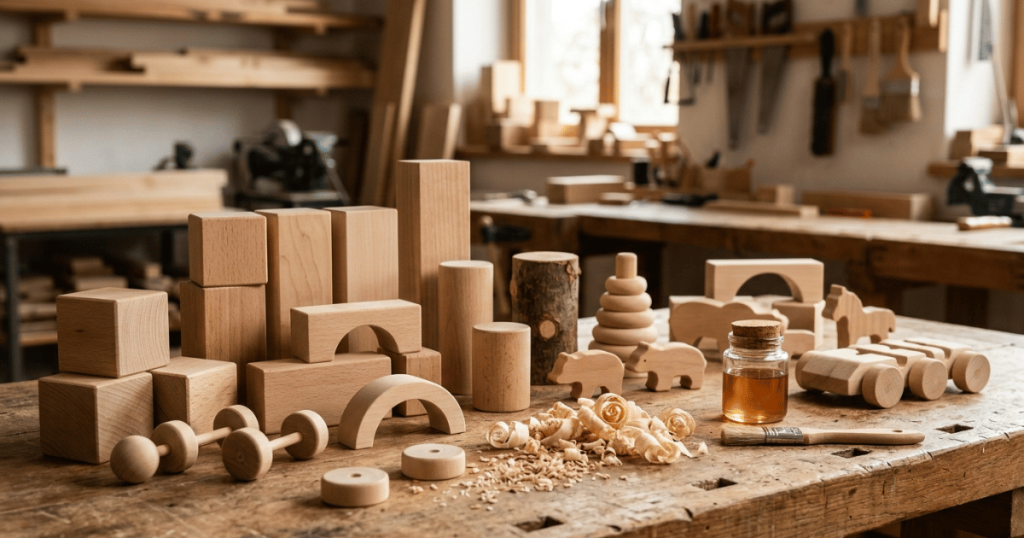
“Wooden Toy” Can Mean More Than Solid Wood
When I first started buying wooden toys for my children, I assumed “wooden” meant that the whole toy had been cut from pieces of solid timber.
It is not always that simple.
A chunky wooden block may indeed be solid wood. A puzzle might have solid wooden pieces sitting on a plywood board, while a large play kitchen can combine solid wood with plywood or engineered panels.
These materials all begin with wood, but they are constructed differently.
That distinction helps explain why two toys described as wooden can feel completely different in your hands. One may be heavy with visible grain running through the piece, while another is lighter and made from several thin layers.
Manufacturers also choose materials according to the job a particular component needs to do. Industry sources describe plywood as especially useful for larger, flatter components because its layered construction can provide dimensional stability without the weight or cost of making every panel from solid wood.
So the material question is often better asked one component at a time.
What Is Solid Wood?
Solid wood means a component has been made from timber rather than manufactured from wood fibers or multiple veneers bonded into a board.
Look at an unfinished solid wooden block and you may be able to follow the natural grain around its surfaces. Each piece can also have small variations because it came from a natural material.
Several species regularly appear in wooden toys.
Beech
Beech is a hardwood with a relatively fine grain. It is widely used for blocks, peg toys, grasping toys, and other pieces that need to stand up to frequent handling.
Its smooth appearance is one reason you may see it in natural-finish toys where the wood remains visible.
Maple
Maple is another dense hardwood commonly mentioned in toy making. It is hard-wearing and fine-grained, making it useful for components that receive repeated handling.
That density can also make a maple toy feel fairly substantial for its size.
Birch
Birch is a name parents may encounter in two different contexts.
A toy can contain solid birch, but birch is also widely used as the veneer in plywood. Seeing “birch plywood” on a description therefore does not mean the item was carved from one solid piece of birch.
That small wording difference is worth noticing.
Rubberwood
Rubberwood is a hardwood obtained from rubber trees, which are primarily grown for latex production. It is commonly used in modern wooden products and appears in blocks, pretend-play toys, and larger children’s items.
It tends to have a light appearance and can take painted finishes well.
Pine and other softer woods
Pine is a softwood commonly used in wooden products and toys. Other species may appear too, depending on the manufacturer and the type of toy.
Softwood does not mean the material is literally soft enough to squeeze.
“Hardwood” and “softwood” are categories related to the trees the timber comes from. Individual species within those groups still vary considerably in density and resistance to dents.
When my son was 4, he had two unfinished wooden vehicles that looked similar from across the room, but one picked up little dents much faster after repeated trips down the edge of his block ramp.
That was one of the first times I noticed how much the actual wood and construction could affect the way a toy aged.
What Is Plywood?
Plywood is real wood arranged differently from solid timber.
It is made from thin sheets of wood called veneers. Manufacturers bond several veneers together, usually with the grain direction alternating between layers.
If you look closely at the exposed edge of an unpainted plywood puzzle board, you can often see those layers.
The layered construction can make plywood stable across a wide, flat surface. That is why it is commonly used for puzzle bases, activity boards, dollhouses, play kitchens, side panels, and other larger or flatter toy components.
Plywood is therefore not automatically a sign of a poorly made wooden toy.
A thick solid wood panel can add weight and may change shape as moisture conditions change. For some designs, properly selected plywood is simply a practical construction material.
Quality can still vary.
The type and thickness of the veneers matter, as do the adhesive, finish, manufacturing quality, and intended use. A thin, poorly finished plywood component should not be treated as equivalent to a well-made one simply because both carry the same material name.
My daughter had a wooden animal puzzle when she was about 5 with chunky solid pieces and a layered puzzle board underneath. At the time I barely noticed that two different forms of wood were being used because each suited its part of the toy.
What Is MDF?
MDF stands for medium-density fiberboard.
Instead of using whole pieces of timber or stacked veneers, MDF is made by breaking wood down into fibers and combining those fibers with binders to form a consistent board.
That gives it a very smooth and uniform surface.
In toy manufacturing, MDF can appear in puzzle boards, back panels, bases, printed surfaces, and certain pretend-play components. Its consistency can be useful where a manufacturer needs a very flat surface for paint or printed artwork.
MDF and solid wood do not behave the same way.
MDF generally does not show natural grain through the board, and damaged edges cannot be repaired in quite the same way as a small mark in solid timber. Moisture can also be particularly troublesome for fiberboard.
You may see strong warnings online claiming that MDF itself makes a toy unsafe because resins and adhesives are used during production. That conclusion is too broad.
Composite wood products can be subject to formaldehyde-emission requirements, and toys also have safety requirements in the markets where they are sold. For a parent, the more practical approach is to look at the complete product, its age suitability, manufacturer information, condition, and relevant compliance rather than treating one material name as a complete safety verdict.
Solid Wood vs Engineered Wood
The easiest distinction is in how the material is formed.
Solid wood comes from timber. Beech, maple, rubberwood, pine, and solid birch pieces are examples.
Engineered wood is manufactured by combining wood layers, fibers, particles, or other wood elements, usually with an adhesive. Plywood and MDF fall into this broader category, although their structures are very different from each other.
That does not create a simple good-versus-bad divide.
Solid wood can be an excellent choice for a chunky block that will be repeatedly dropped. Plywood can make more sense for a broad, flat puzzle board where stability matters. MDF may be selected for a smooth printed panel.
The location of the material inside the toy matters.
This is one reason I prefer product descriptions that tell me more than “made of wood.” Knowing which materials are used gives parents a clearer picture of what they are actually buying.
Paint, Oil, Wax, and Finish Are Part of the Toy Too
The wood is only the starting point.
A finished wooden toy may be painted, stained, oiled, waxed, or covered with a clear protective coating. These surface materials affect what you see and touch just as directly as the wood underneath.
Some manufacturers leave much of the grain visible. Others use opaque colors that make identifying the underlying material by sight difficult.
Water-based paints are common in modern wooden toys, while oils and waxes are often seen on toys designed to retain a more natural wood appearance.
The finish also changes how the toy ages.
A painted surface can eventually show chips or worn edges. An oiled solid wood surface may develop marks differently, and unfinished wood can show dirt or moisture more readily.
Whatever the finish, I look for smooth surfaces and intact coatings rather than assuming “natural” automatically means better.
Can You Tell What a Wooden Toy Is Made From Just by Looking?
Sometimes there are clues, but appearance alone can mislead you.
Exposed plywood edges often reveal visible layers. Solid wood may show continuous grain, while MDF usually has a uniform fiber-like interior if an unfinished edge is visible.
Paint can hide nearly all of those clues.
Weight is not definitive either. Different solid wood species have different densities, and the dimensions and internal construction of the toy affect how heavy it feels.
The product description or manufacturer information is usually more useful.
Look for specific terms such as “solid beech,” “rubberwood,” “birch plywood,” or “MDF” rather than relying only on a broad phrase such as “premium wood.”
If the material matters to you and the listing does not explain it, that missing information is worth noticing.
Material Is Only One Part of a Good Wooden Toy
Knowing what a wooden toy is made of helps you understand it, but the wood species alone cannot tell you the whole story.
Construction matters.
Check whether edges and surfaces are smooth. Look at joints and attached components, and pay attention to cracks, splinters, peeling coatings, or damage as the toy gets older.
Age suitability matters as well, particularly when toys contain small or detachable pieces.
Sourcing can be another consideration. If responsible forestry is important to your family, certification such as FSC relates to the source of wood rather than telling you that one particular wood species is automatically sustainable.
Durability depends on the whole design too.
A well-designed toy can use more than one material because different components have different jobs. A solid wood frame combined with a plywood panel is not necessarily a compromise. It may be exactly what the design calls for.
After years of wooden toys moving through our house, I pay less attention to whether every piece is solid wood and more attention to whether the manufacturer clearly identifies the materials and whether the construction makes sense for how the toy will actually be used.
That tells me much more.
Frequently Asked Questions
What type of wood are wooden toys usually made from?
Common choices include beech, maple, birch, rubberwood, and pine. Manufacturers may also use plywood or MDF for certain components depending on the toy’s design.
Are wooden toys always made from solid wood?
No. A toy described as wooden may contain solid wood, plywood, MDF, or a combination of materials. Large toys and puzzles often use different materials for different components.
Is plywood real wood?
Yes. Plywood is an engineered wood product made by bonding thin sheets of real wood veneer in layers. Its layered structure makes it particularly useful for stable, flat toy components.
What is the difference between plywood and MDF?
Plywood is made from layers of wood veneer, while MDF is made from wood fibers combined with binders and pressed into board. This difference gives the two materials different structures and physical properties.
Is solid wood always better than engineered wood for toys?
No single material is ideal for every toy component. Solid wood can work very well for blocks and chunky pieces, while plywood may be more practical for large, flat panels. Construction quality, intended use, finish, condition, and applicable toy safety requirements all matter.