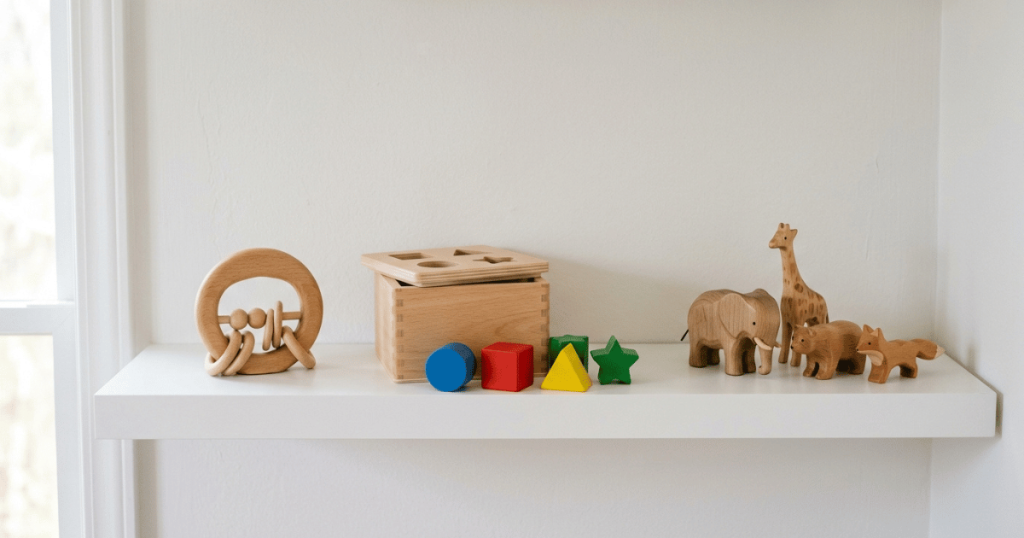
Quick Answer: To choose wooden toys by age, start with the manufacturer’s age and safety guidance, then consider what the child can comfortably grasp, build, solve, or imagine right now. The best fit offers enough challenge to stay interesting without depending on skills the child has not developed yet.
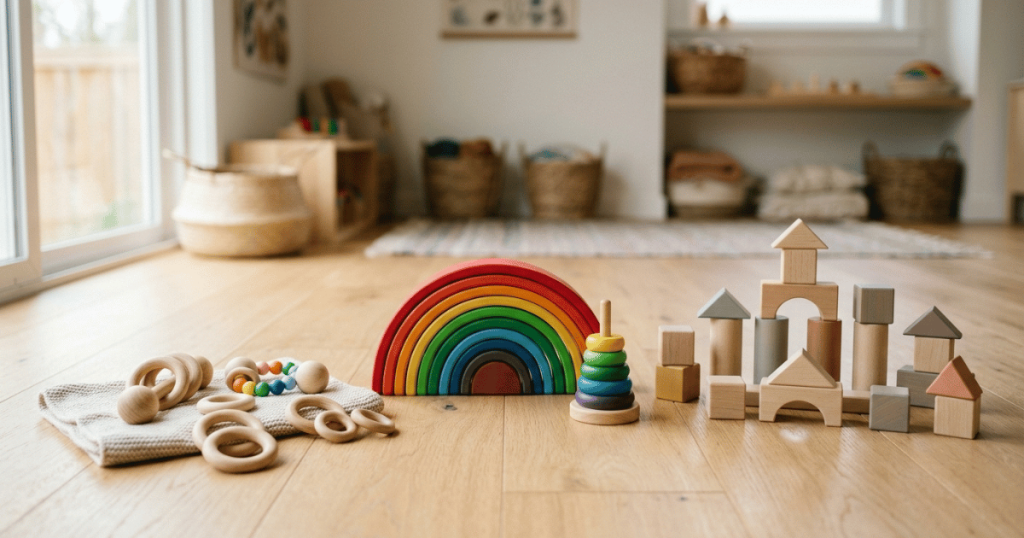
Age Is the Starting Point, Not the Whole Decision
Age labels are useful because they give you an immediate first filter, especially where small pieces or more complicated play are involved. I always treat the stated minimum age seriously, but after that, I think about the child in front of me.
Two children who are both six can play very differently.
One may happily spend half an hour planning a complicated block structure, while another would rather use the same blocks as houses, roads, and furniture in an imaginary town. Neither child needs a toy chosen simply because it says “6+” on the package.
The same idea applies when children are younger. Their ability to grasp pieces, follow a simple sequence, solve a puzzle, or stay interested in one activity can vary considerably.
That is why choosing by age works best when you combine the number on the label with what you already know about the child’s play.
How to Choose Wooden Toys by Age, Step by Step
Step 1: Check the Manufacturer’s Age Guidance First
Start with the minimum age and any warnings provided with the toy.
This matters most with babies and toddlers because small components can create choking hazards. A toy that looks simple may still contain detachable pieces or other features intended for an older child.
Do not move down an age range simply because your child seems advanced. Skill and safety are separate questions.
Step 2: Look at What the Child Can Already Do
Think about the actions the toy requires.
Does the child need to grasp a large piece, fit shapes into matching holes, balance blocks, follow several steps, or understand rules? Compare those demands with the way the child currently plays.
When my son was five, he could spend ages arranging small wooden animal figures into rows, but a more structured puzzle with several similar-looking pieces could lose him quite quickly. That little difference told me more about what would hold his attention than his birthday alone.
A suitable challenge gives the child somewhere to grow without making every attempt feel frustrating.
Step 3: Match the Toy to the Child’s Current Kind of Play
Watch what the child repeatedly chooses to do.
Babies may explore through grasping, reaching, rolling, and simple cause and effect. Toddlers often become interested in stacking, sorting, pushing, pulling, and putting things inside other things.
Preschool play can become more imaginative. A few wooden blocks might become a garage one afternoon and a pretend bakery counter the next.
By school age, many children are ready for more complicated construction, puzzles, strategy, creative projects, and activities that take longer to complete.
Following these patterns makes age-based choosing much more useful.
Step 4: Check Whether the Challenge Has Room to Grow
Some toys have a very narrow window of usefulness. Once the child masters the single action, there may be little reason to return to them.
Open-ended wooden toys can sometimes avoid this problem because children can change the way they use them.
A young child may simply stack blocks. Later, those same pieces can become bridges, houses, obstacle courses, or part of an invented game with rules.
My daughter had a small set of plain wooden blocks when she was younger, and I remember one afternoon when the tallest “castle” suddenly became a zoo because she added a little wooden giraffe beside it. The blocks had not changed, but the way she thought about them had.
Step 5: Think About Real-Life Practicality
Before deciding, look at the size of the toy and how many separate pieces come with it. Consider where those pieces will be played with and where they will go afterward.
This becomes especially important with gift ideas by age.
If you are buying for someone else’s child, you may not know how much floor space the family has or whether they already own three similar sets. A manageable, age-appropriate activity can be a more thoughtful gift than a huge set chosen mainly because it looks impressive.
What Changes as Children Get Older?
The progression is less about buying increasingly complicated toys and more about matching how play changes.
For babies and very young toddlers, physical interaction is central. Large, easy-to-handle pieces and simple actions suit hands that are still learning how to grasp, release, place, and coordinate movements.
As toddlers gain control, stacking and sorting can add simple problem-solving. Chunky puzzles and similar activities can also give them opportunities to practice hand-eye coordination.
Preschoolers often begin combining these physical skills with stories and ideas. Building pieces, play scenes, figures, and other open-ended materials can become part of increasingly detailed pretend play.
For children around six and older, complexity can come from planning rather than simply having more pieces. Construction challenges, detailed puzzles, pattern activities, and games with understandable rules may hold attention longer because the child has to think ahead.
Older children should not automatically be pushed away from simple wooden toys, either.
A seven-year-old can use ordinary blocks in a much more sophisticated way than a three-year-old. What matters is whether the play still offers something interesting to create, solve, change, or imagine.
How to Tell When the Age Is Right but the Toy Is Wrong
Sometimes a toy fits the age recommendation perfectly and still does not fit the child.
Repeated frustration is one clue. If the child cannot get started without an adult completing most of the activity, the challenge may currently be too high.
The opposite can happen as well.
If the entire activity is finished almost immediately and the child never returns to it, it may no longer offer enough challenge. Before deciding it has been outgrown, though, see whether there is another way to use it. Blocks can move from stacking to construction, and figures can move from naming objects to storytelling.
Interest matters too. A child fascinated by vehicles may engage deeply with building roads and garages, while another child of exactly the same age might prefer animals, patterns, or pretend cooking.
Age narrows the field. Observation helps you make the final choice.
Safety Still Comes Before Developmental Readiness
Wood itself does not automatically make a toy suitable or safe for every age.
Follow the manufacturer’s minimum-age guidance and warnings. For younger children, pay particular attention to small or detachable components, since mouthing objects is common during early childhood.
Check wooden toys during regular use as well. A toy that was fine when new can become damaged after repeated drops and rough play. Cracks, splinters, loose pieces, or damaged surfaces are reasons to take it out of play until you know it is safe to use.
There is another practical issue in homes with children of different ages.
An older child’s wooden set may contain small pieces even when the younger child’s own toys do not. In our house, keeping different-age toys separated became much more important once one child was ready for smaller pieces and the other still wanted to investigate almost everything by hand.
Supervision and sensible storage matter just as much as choosing the correct age range in the first place.
Choosing a Wooden Toy as a Gift
When you are choosing for your own child, you have weeks or months of everyday observation to guide you. Gift buying can be harder because you may only know the child’s age.
Start with the stated age range, then ask one or two simple questions about interests and what the child already owns.
For a younger child, I would also want to know whether there is a baby or toddler sibling in the home before choosing anything with smaller components. For an older child, I would think more about whether the activity offers enough depth to stay interesting after the first play session.
The most useful gift ideas by age are really age-plus-child ideas.
A toy does not have to teach a named skill or look advanced to be worthwhile. If it is safe for the age, suits the child’s abilities, and gives them something meaningful to do with their own hands and imagination, it has already passed the tests that matter most to me as a parent.
Frequently Asked Questions
What age are wooden toys suitable for?
Wooden toys can be suitable across many ages, from infancy through the school years, depending on the individual toy. Always follow its stated minimum age and safety information rather than assuming that every wooden toy is suitable for young children.
How do I choose an age-appropriate wooden toy?
Check the manufacturer’s age guidance first, then consider the child’s current skills, interests, and way of playing. Look for something they can begin using without constant adult help but that still leaves room for exploration or a little challenge.
Are wooden toys safe for babies?
Some wooden toys are made specifically for babies, but the material alone does not make a toy baby-safe. Choose only toys labeled for the baby’s age and check the manufacturer’s safety information, construction, piece size, and condition.
Should I buy toys above my child’s age to challenge them?
It is better to choose a toy that safely fits the child’s current age while offering room for more complex play. Never ignore a minimum-age warning simply because a child appears capable of handling the activity.
What wooden toys work well for children age six and older?
School-age children may enjoy wooden construction activities, puzzles, pattern-based play, games, and open-ended pieces that allow more detailed planning and imaginative play. The best choice depends on the individual child’s interests and the level of challenge they currently enjoy.