
Quick Answer: Babies can be introduced to wooden toys from the earliest months if the individual toy is specifically suitable for their age and stage. At first, play may simply mean looking and listening; once your baby begins reaching and grasping, lightweight wooden rattles or grasping toys can become much more interesting.
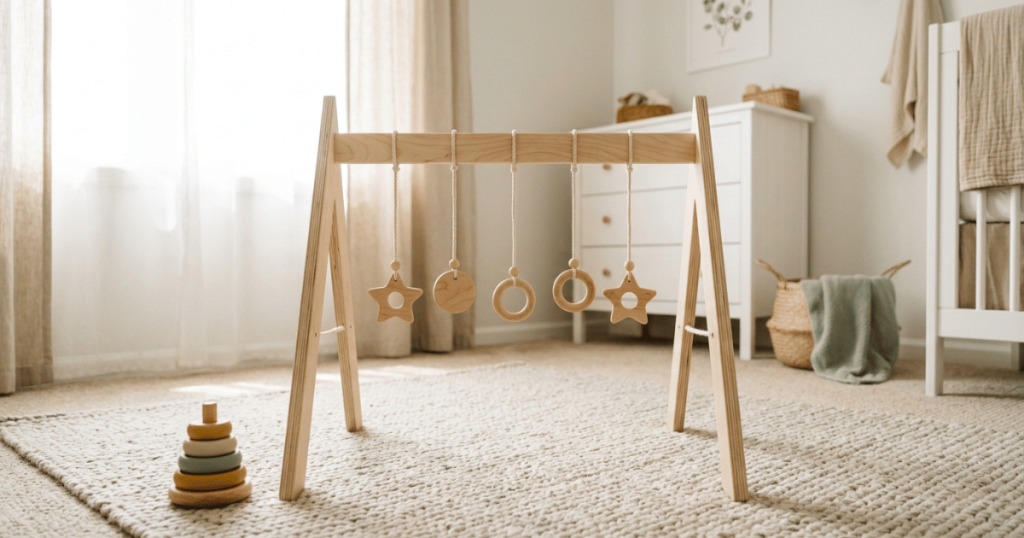
There Is No Single Starting Age for Every Wooden Toy
When parents ask when babies can play with wooden toys, the simplest answer is that wood itself does not determine the starting age. The design of the toy does.
A smooth wooden rattle made specifically for young babies is very different from a box of wooden building blocks intended for an older child. One may be appropriate during infancy, while the other needs to wait until your baby has developed the skills to handle it safely.
This distinction helped me much more than looking for one magic age.
With both of my children, I found that the early months were less about “playing” in the way we imagine an older baby playing. A very young baby might watch an object move or react to its sound. Later comes reaching, gripping, mouthing, shaking, and eventually deliberately banging one object against another.
That gradual change is a better way to think about infant readiness.
What Wooden Toy Play Looks Like During the First Year
During the first few months, babies are taking in an enormous amount through sight, sound, touch, and movement. They do not need a complicated toy to make that happen.
A wooden object designed for this age might initially be something you hold and gently move where your baby can see it. Once reaching becomes more purposeful, a light grasping toy or baby-safe wooden rattle gives those little hands something tangible to explore.
I remember my son becoming fascinated by a small wooden ring at around four months. He spent far more time trying to get the edge accurately into his mouth than doing anything I would have called “playing” at the time.
That mouthing is worth expecting.
Babies explore objects with their mouths as well as their hands, especially during the first year. Any wooden toy within reach therefore needs to be suitable for that particular baby and free of loose pieces, rough areas, or questionable finishes.
As sitting and hand control improve, play changes again. Babies may pass a toy from one hand to the other, shake it deliberately, bang it on the floor, or drop it repeatedly just to see what happens.
Later in the first year, larger blocks and simple stacking pieces may become interesting when they are designed and age-rated appropriately. At first, your baby may have absolutely no interest in building a tower. Picking up a block, turning it over, banging two pieces together, and knocking down the tower you built are all perfectly reasonable forms of play.
Watch Your Baby’s Readiness, Not Just the Calendar
Age recommendations matter for safety, but babies do not suddenly gain a new set of play skills on a particular birthday.
You can also watch what your baby is doing with everyday objects.
Purposeful reaching is one useful sign. So is being able to close the hand around an appropriately sized object and hold it for a short time. Later, you may notice your baby passing objects between hands or deliberately shaking and turning them.
These small changes tell you much more about what kind of play will actually hold your baby’s attention.
My daughter was particularly fond of dropping things once she discovered that skill. A wooden rattle would go over the side of her play mat again and again, and the sound of it landing seemed almost as interesting to her as holding it.
That stage also taught me to think about weight.
A toy that feels pleasantly solid in an adult hand can be surprisingly heavy when a baby drops it onto their own face, foot, or bare toes. For early wooden toys, I prefer designs that are manageable for small hands rather than assuming heavier means better quality.
The Safety Check Matters More Than the Material
Wooden does not automatically mean baby-safe.
For an infant, start by checking the manufacturer’s stated age range and warnings. The toy should be intended for a child at your baby’s stage, rather than being an attractive wooden object that happens to look simple.
Then look closely at the actual toy. Its surface should feel smooth, with no splinters or sharp edges. Paint or other finishes should be appropriate for children’s toys, particularly when mouthing is likely.
Small detachable parts are an obvious concern because babies put so much into their mouths.
Construction matters too. Check that fixed pieces remain secure and that nothing has loosened. If a toy contains moving components, consider whether tiny fingers could become trapped.
I also inspect wooden toys again after they have been in use for a while.
Babies are surprisingly hard on them. They chew, throw, bang, and drool on toys, and repeated cleaning adds more wear. A toy that was perfectly smooth when new should be taken out of play if it later develops a crack, splinter, loose piece, peeling coating, or other damage.
Mouthing a Wooden Toy Changes What You Need to Check
Once your baby starts bringing everything to the mouth, assume that any handheld toy will eventually get there.
This is where the difference between a decorative wooden object and an actual infant toy becomes important. A wooden item can look natural and beautifully made without having been designed to withstand baby play or mouthing.
For toys intended for babies, check the labeling and care instructions rather than guessing from appearance.
Size matters as well. Babies should not have access to small pieces that could become choking hazards, including parts that might break or detach from a larger toy.
Keep the toy clean according to its manufacturer’s directions. Wood and water do not always get along well, so soaking a wooden toy simply because it has been chewed is not necessarily the right cleaning method.
Simple Wooden Toys Can Match Changing Baby Skills
One thing I like about simple toys is that the baby’s own actions provide most of the activity.
Early on, holding a rattle practices grasping. Reaching toward it brings the eyes and hands together. Shaking it creates a simple cause-and-effect experience: the hand moves, then a sound follows.
Those interactions can support the fine motor skills and hand-eye coordination babies are gradually developing through ordinary play.
A few months later, the same baby may be much more interested in banging, turning, dropping, and retrieving objects. Eventually, appropriately sized stacking pieces or blocks can introduce placing and balancing.
There is no need to rush toward the next type of play.
If your baby mainly wants to hold a wooden ring and chew it, that is useful exploration for the stage they are in. A toy does not have to be used in its most obvious adult-approved way to be interesting.
So, What Is a Safe Age to Start?
For a wooden toy specifically designed and labeled for young babies, introduction can begin in the earliest months. At that point, you may be doing much of the holding while your baby watches, listens, or reaches.
Once your baby begins intentionally grasping objects, lightweight wooden rattles and grasping toys can become more interactive. During the second half of the first year, increasing hand control opens the door to more manipulation, banging, transferring, and eventually simple stacking or fitting activities when the individual toy is appropriate.
The important part is matching three things: your baby’s current abilities, the toy’s stated age guidance, and the condition and construction of the toy.
That approach is more useful than deciding that all wooden toys become suitable at six months, nine months, or one year. Babies develop gradually, and wooden toys cover an enormous range of designs.
Start simple, stay nearby, and watch what your baby actually does with the toy.
Frequently Asked Questions
Are wooden toys safe for newborns?
Some wooden toys can be suitable from birth when the manufacturer specifically labels them for newborn use. Always follow the individual toy’s age guidance and check its size, construction, finish, and condition before giving it to a baby.
Can babies chew on wooden toys?
Babies naturally mouth toys, so only give them wooden toys intended for their age and use. Check that the surface and finish are suitable, and stop using the toy if you notice splintering, cracking, peeling, or loose parts.
What wooden toys can a 6-month-old play with?
A 6-month-old who is reaching and grasping may enjoy simple, lightweight wooden rattles, grasping toys, or other large pieces specifically designed for that age. The manufacturer’s age recommendation should always take priority over a general age-based suggestion.
When can babies play with wooden blocks?
Wooden blocks become appropriate when the particular set is age-rated for your baby and the pieces are safely sized and manageable. Early play may simply involve holding, banging, turning, or dropping a block rather than stacking it.
How do I know my baby is ready for more interactive wooden toys?
Look for changes such as purposeful reaching, a steadier grasp, passing objects between hands, deliberate shaking, or trying to place and retrieve objects. These signs of infant readiness can help you choose a toy that matches what your baby is currently able and interested in doing.
