
Quick Answer: You can often introduce large, age-appropriate wooden blocks at around 6 months, once your baby is reaching for and holding toys, but there is no single right age for blocks. At first, expect grasping, banging, dropping, and mouthing rather than building. Intentional stacking usually comes later, during the second year.
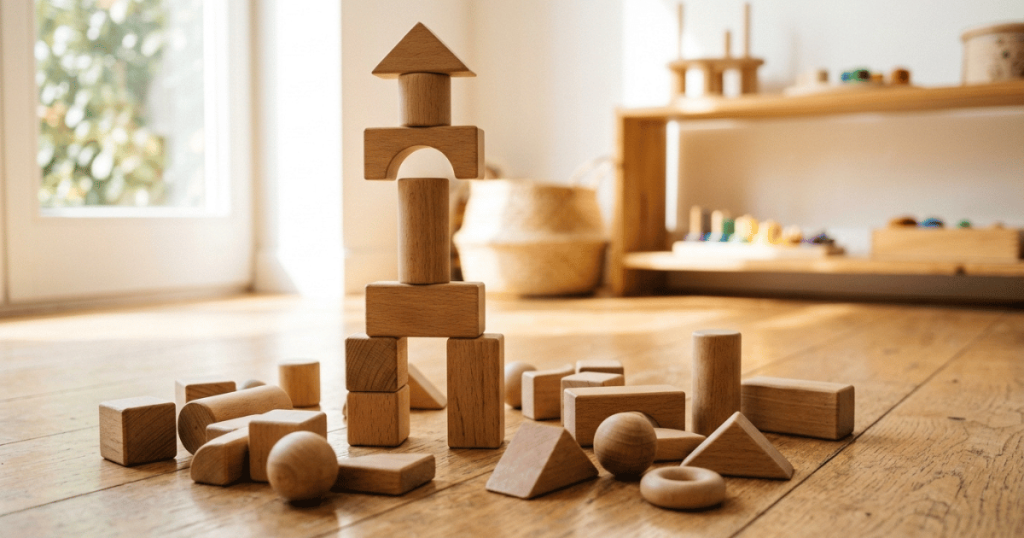
Around 6 Months Is Often a Good Starting Point
For many babies, the first half of the first year is when toys begin to become much more interesting to their hands. Once your baby is deliberately reaching for objects and holding them, a large, simple wooden block can become something new to explore.
That does not mean a 6-month-old is expected to build with it.
Early block play looks wonderfully basic. Your baby may grab a block, turn it over, bang it on the floor, pass it between hands, or immediately put it in their mouth. All of that gives those little hands practice controlling an object, while also introducing differences in weight, shape, texture, and sound.
When my son was around this stage, the most interesting thing about a block was not anything I built with it. He wanted to tap one chunky block against the floor again and again, then stare at it as though the block had personally made the noise for him.
That kind of simple experimentation is enough.
Watch Your Child’s Hands, Not Just the Calendar
Age gives you a useful starting point, but readiness tells you more.
A baby who can purposefully reach for a toy, close their fingers around it, and move it from one hand to the other already has several of the early motor skills that make block exploration interesting. Sitting steadily, either independently or with appropriate support for their stage, can also free both hands for play.
You do not need to wait until your child can stack.
In fact, stacking requires considerably more control than simply holding a block. A toddler has to pick the block up, guide it to the right position, judge where to place it, and release it gently enough that the tower stays standing. Those abilities arrive gradually.
This is why the right age for blocks can sound confusing when you read different recommendations. One source may be talking about when babies can hold blocks, while another is describing when toddlers can actually build with them.
What Block Play Usually Looks Like as Skills Grow
Between roughly 6 and 12 months, exploration tends to come first. Babies may hold blocks, transfer them between hands, bang two together, drop them, or knock over something you build.
Knocking down towers deserves more credit than it gets.
A baby watches your little tower stand, reaches toward it, and discovers that one push changes everything. Repeating that game gives them a very simple experience of cause and effect while they practice directing their hands toward a target.
During the second year, placing starts to become more deliberate. Your toddler may try to put one block on another, although the first attempts often slide straight off. Eventually two blocks stay upright, then another gets added.
My daughter went through a phase where she would carefully place a red square block on top of another one, clap when it stayed there, and immediately knock both across the rug. For her, building and demolishing were clearly parts of the same game.
As toddlers move toward ages 2 and 3, blocks can become much more than towers. You may see rows that become roads, little enclosures, color sorting, pretend food, or buildings for toy animals. Fine motor skills and hand-eye coordination are still involved, but imagination and problem-solving become increasingly visible too.
Wooden Blocks Need to Match the Stage
The word “wooden” does not automatically tell you whether a block is suitable for a baby.
For a younger child, size and construction matter enormously. Blocks should be large enough that they do not present a small-parts hazard, and they should be comfortable for small hands to hold. A heavy block that is awkward for a baby to control can also make those enthusiastic bangs and drops less pleasant.
Check the manufacturer’s age guidance for the particular set rather than assuming every wooden block is appropriate from the same age.
Because babies commonly explore toys with their mouths, I also pay much closer attention to the physical condition of wooden toys during this period. Run your fingers over the block occasionally. If you notice a crack, splintering, a loose component, or a finish that is peeling or badly damaged, take that piece out of play.
Smooth surfaces and securely made pieces matter more at this stage than decorative details.
The same caution applies if older children also play in the house. Their block sets may contain much smaller pieces, so a set that is perfectly appropriate for a 5-year-old should not automatically end up mixed into a baby’s play area.
How I Like to Introduce Blocks for the First Time
There is no need to put a large basket of blocks in front of a baby and demonstrate everything they can eventually do.
Start with just a few appropriate pieces on the floor during normal play. Let your child pick one up and investigate it. If they bang it, drop it, or mouth it, that is information gathering from their point of view, not a failed attempt at building.
You can make a tiny tower yourself and allow your baby to knock it over.
As their control improves, try handing them a block while you hold another. Tap yours gently, place it down, or put one block on another. Children often learn a surprising amount simply from watching and copying without being repeatedly shown a “correct” way to play.
Talking naturally adds another layer. You might say “big block,” name a color, or count two blocks as you place them down. There is no need to turn ordinary block play into a lesson.
Follow their interest, then stop when they lose it.
Do Not Worry If Stacking Takes a While
One of the easiest mistakes with developmental toys is expecting the activity pictured in our heads to happen immediately.
You introduce blocks because you imagine a tiny tower. Your child decides the important experiment is carrying one block across the room and dropping it into a basket twenty times. That difference is normal, especially in the early stages.
Children develop hand control at different rates, and block play changes alongside those skills. The usual age ranges are useful for understanding the general progression, but they are not deadlines a child needs to meet because a block set is sitting on the shelf.
There is also no reason to keep correcting a toddler whose buildings fall over. Balancing wooden blocks takes practice because the pieces do not magically stay together. Trying a position, watching it collapse, and trying something different is part of what makes simple blocks useful for early problem-solving and spatial awareness.
If you have broader concerns about your child’s development or motor skills, that is a different question from whether they have built a particular number of blocks. Your pediatrician or another qualified healthcare professional is the appropriate person to ask about those concerns.
Frequently Asked Questions
Can a 6-month-old play with wooden blocks?
Often, yes, provided the particular blocks are designed for that age and are large, smooth, securely made, and used with supervision. At 6 months, playing usually means grasping, mouthing, banging, and dropping rather than stacking.
When do babies start stacking blocks?
Intentional stacking generally comes later than basic block exploration, often during the second year. Early towers may contain only two blocks, and children develop this skill at different rates.
Should I start with soft blocks before wooden blocks?
You do not have to follow one fixed sequence. Soft blocks can be practical for very early exploration, while suitable large wooden blocks may also work once a baby has enough hand control, provided you follow the toy’s age guidance and supervise play.
What should I look for before giving wooden blocks to a baby?
Check the recommended age, piece size, weight, surface, edges, and overall condition. Avoid pieces with small detachable parts, cracks, splinters, or damaged finishes, especially while your child still explores toys with their mouth.
What if my toddler only knocks blocks down?
That is a perfectly useful stage of block play. Knocking towers down lets toddlers practice hand-eye coordination and explore cause and effect, and purposeful building can develop gradually as their control improves.
