Quick Answer: Beech and hard maple are two of the best all-around woods for wooden toys because they are dense, durable, and fine-grained. Birch and rubberwood can also be very practical choices, while softer woods such as pine and basswood make more sense for certain toys where low weight, easy shaping, or lower cost matters.
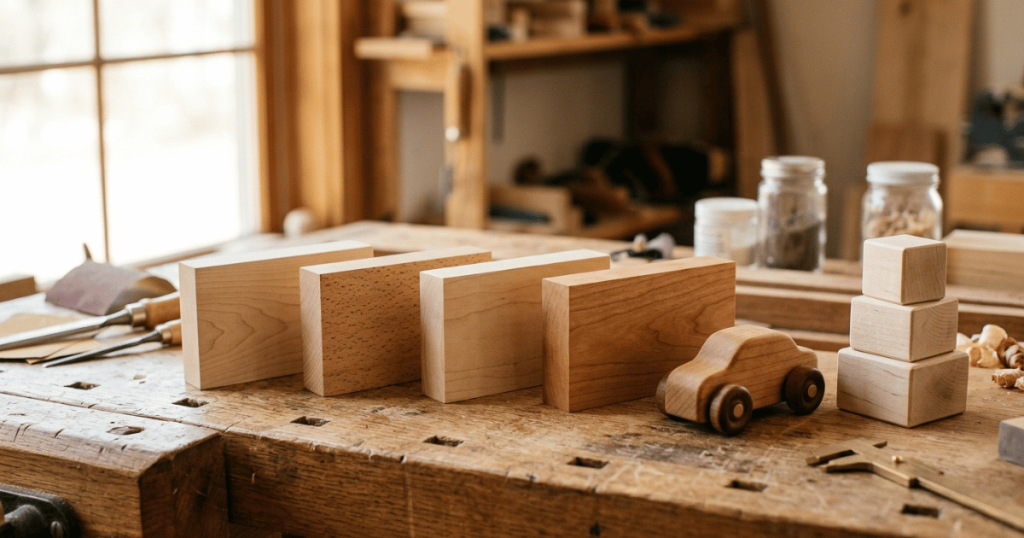
There Is More Than One Good Toy Wood
When I first started paying attention to what my children’s wooden toys were actually made from, I expected a simple answer. I thought there would be one wood that was clearly better and that I could simply look for that name whenever I bought another toy.
Real toys made that idea fall apart pretty quickly.
Different toys ask different things from wood. A block that gets knocked repeatedly onto a hardwood floor needs excellent resistance to dents and splitting. A large pretend-play piece can benefit from being lighter, while a small carved animal needs wood that can hold its shape and finish smoothly.
That is why the best wood for wooden toys depends partly on what the wood is being asked to do.
In our house, I noticed this difference when my son was about four and repeatedly sent a little wooden car down the edge of our coffee table. The wheels and body took far more impact than the decorative wooden pieces sitting in his play kitchen.
Wood species matters, but construction matters just as much.
A beautifully chosen hardwood can still make a disappointing toy if the surface is rough, the edges are poorly finished, or pieces begin separating. When buying for children, we look at the whole toy rather than treating the wood name as a guarantee of quality.
Why Beech Is So Common in Wooden Toys
Beech is one of the names you will see again and again when looking at well-made wooden toys.
It is a hardwood with a fairly fine, even texture. Its density helps it stand up to repeated handling and impact, while its relatively smooth grain makes it suitable for pieces children touch constantly.
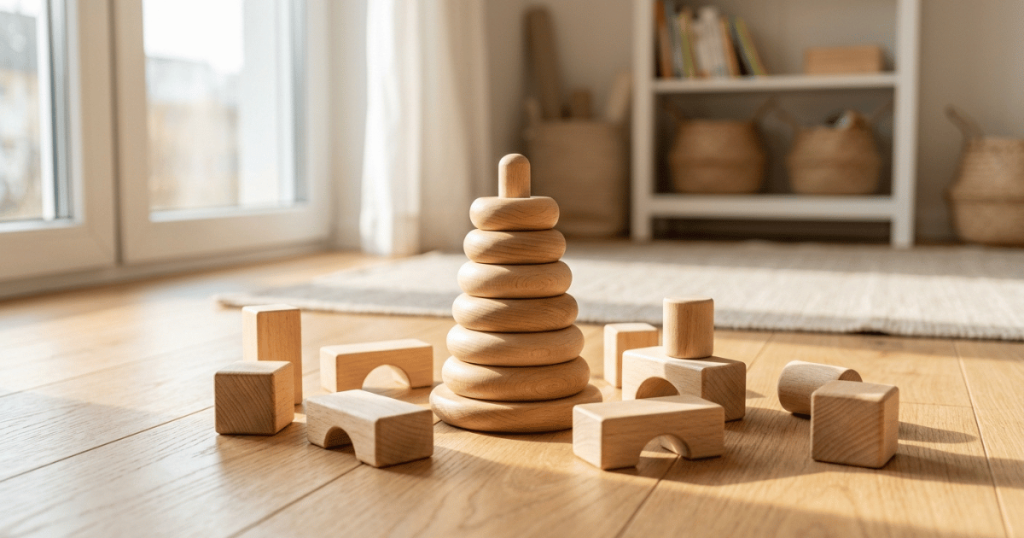
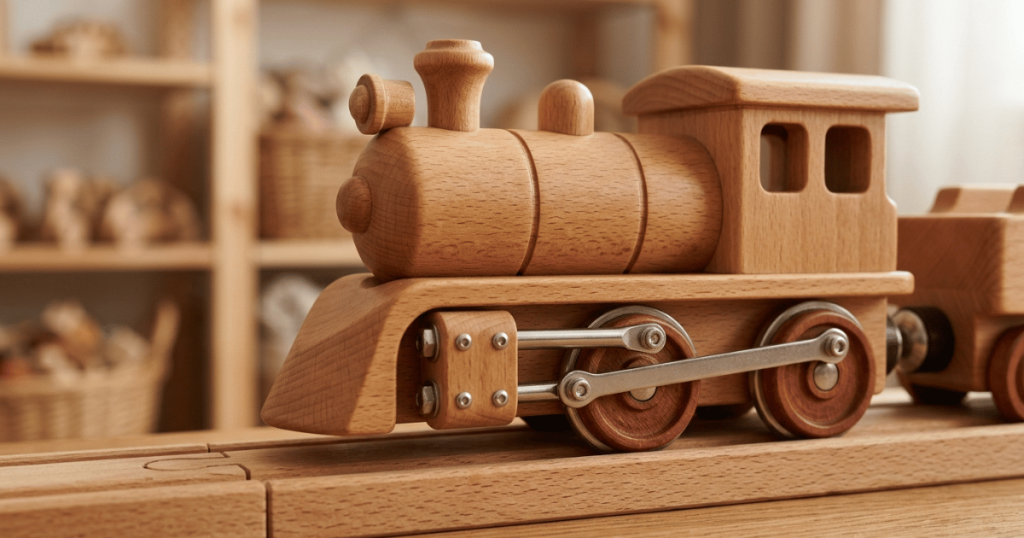
That combination works especially well for blocks, toy vehicles, stacking pieces, game pieces, and other toys that need to keep their shape through regular play.
Beech also has a light, fairly neutral appearance. Toy makers can leave much of the natural wood visible or apply color without fighting a very dramatic grain pattern.
For a parent, though, the practical advantage is longevity.
My daughter had a set of pale wooden stacking pieces when she was around six that regularly ended up mixed into bins with heavier toys. What stayed with me was how little the surfaces changed compared with some softer wooden pieces we owned, which picked up obvious dents much faster.
Beech can still become scratched or damaged. No natural material is immune to years of being dropped, knocked together, and dragged across floors.
Its balance of hardness, smoothness, and durability simply makes it a very sensible all-around material.
Hard Maple Is Excellent When Durability Matters
Hard maple is another particularly strong choice.
It is dense and has a tight grain, which helps a properly made maple toy develop a very smooth surface. It also resists dents better than many softer woods, something that becomes valuable when a toy gets daily use.
You may see maple used for blocks, rattles, rings, wheels, and smaller solid pieces.
The density does add weight. That is not automatically a disadvantage, but it reminds us why choosing wood should be connected to the design of the toy rather than a rule that harder always means better.
A chunky maple block can feel reassuringly solid in your hand.
A very large toy made entirely from dense hardwood could simply be heavier than it needs to be.
For babies and toddlers, parents should also look beyond the wood species. The dimensions of pieces, smoothness of the surface, construction, finish, and age guidance are all part of deciding whether a particular toy is appropriate.
Birch Offers a Useful Middle Ground
Birch is another common name in the wooden-toy world, although you need to pay attention to what the label actually says.
Solid birch is a relatively strong, light-colored wood with an even appearance. It can be used for toys where durability and a smooth finish are important without necessarily having the heavier feel of some dense hardwoods.
You may also encounter birch plywood.
Plywood is made from thin layers of wood bonded together with the grain running in alternating directions. That layered construction makes a good plywood panel stable and useful for broad, relatively thin shapes.
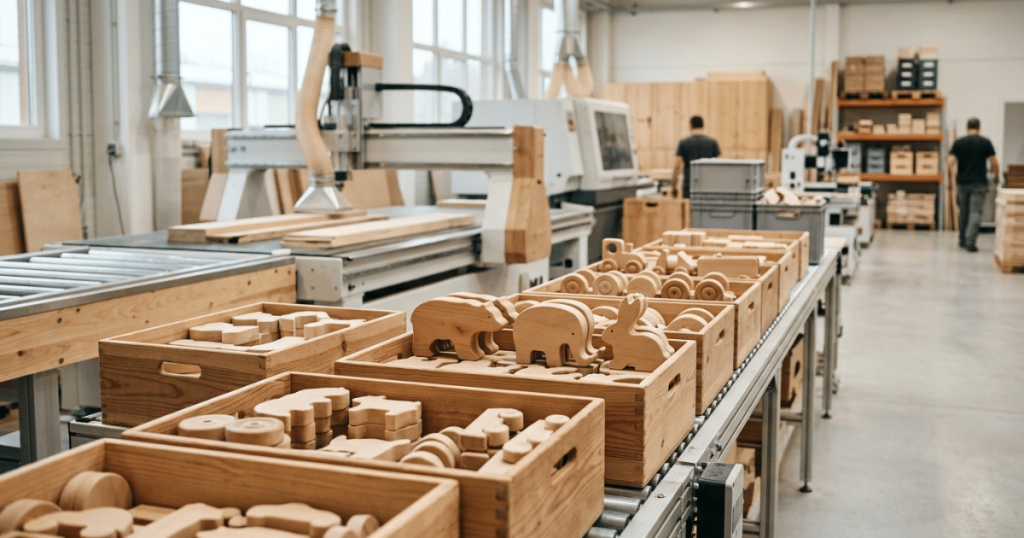
This is why plywood often appears in puzzle boards, dollhouses, play structures, and flat toy components.
It should not automatically be treated as an inferior substitute for solid wood.
What matters is the quality of the material and how appropriately it is used. A flat puzzle board has different structural needs from a small block that a toddler repeatedly throws onto the floor.
When a product description simply says “birch,” checking whether that means solid birch or birch plywood gives you a clearer idea of what you are buying.
Rubberwood Is Worth Understanding
Rubberwood sometimes sounds like an engineered material if you have never come across the name before, but it is real hardwood.
It comes from rubber trees that were originally grown for latex production. After those trees reach the end of their productive latex-growing period, their wood can be used for furniture and toys instead of simply being discarded.
That gives rubberwood an interesting sustainability story.
It is generally light in color and can be made into smooth, attractive toy parts. You will find it in stacking toys, pretend-play pieces, puzzles, figures, and many other types of wooden toys.
Rubberwood is not identical to hard maple or beech in its physical characteristics, so there is little value in treating the three names as interchangeable.
For parents, I find it more useful to ask whether the finished toy feels solid and smooth and whether its construction suits the kind of play it will receive.
Sustainability also involves more than the species name. If responsible forestry matters to you, sourcing information and recognized forest-management certification can tell you more than a vague “eco-friendly wood” statement.
Pine Can Be Fine, but Expect More Wear
Pine often gets a poor reputation in discussions about children’s wooden toys because it is softer than woods such as maple and beech.
Softness changes what happens during everyday play.
A pine surface generally dents and marks more easily. Corners can show wear sooner, and thin or poorly prepared pieces may be less suitable for rough treatment than dense hardwood pieces.
That does not mean every pine toy is bad.
Pine is lightweight, widely available, and relatively easy to shape. Those properties can make sense for larger toy structures or other pieces where extreme hardness is unnecessary.
I once noticed a small dent appear on a soft wooden piece after my five-year-old son dropped a heavier block directly onto it. The toy remained completely usable, but that tiny mark made the difference between softer and denser wood very easy to understand.
Parents who like wooden toys partly because they develop a lived-in look may not mind those marks at all.
If you expect a toy to stay relatively crisp through years of hard use or to be handed down between several children, a denser hardwood may be a better fit.
Basswood Works Better for Some Jobs Than Others
Basswood is soft, lightweight, and easy to carve.
Those qualities make it useful when a maker needs to create detailed shapes. Figurines, decorative pieces, and some carefully carved toys can benefit from a material that is easier to shape than hard maple.
The trade-off is durability.
Basswood will generally dent more readily than dense hardwoods, so I would pay closer attention to the thickness and intended use of a basswood toy. A carefully carved figure used for imaginative play has very different demands from a set of blocks that children repeatedly bang together.
This is a good example of why wood comparisons need context.
A softer wood can be excellent at the job it was chosen for even though it would perform poorly in another type of toy.
Hardwood Versus Softwood Is Only the Beginning
The words “hardwood” and “softwood” are useful, but they can also be misleading if we treat them as simple quality grades.
These categories are botanical. Hardwoods come from broad-leaved flowering trees, while softwoods generally come from conifers. The names do not create a perfect hardness scale for every species.
For toy buying, the actual properties of the particular wood are more useful.
Density affects how easily the surface dents. Grain structure influences how the wood works and finishes, while dimensional stability matters when pieces need to stay flat or fit together accurately.
Then there is the design itself.
A thick, well-shaped piece made from a moderately soft wood may survive family life better than a thin, poorly constructed piece of harder wood. Smooth sanding, sensible edge shaping, sturdy joints, and an appropriate finish all contribute to the final result.
So I would never buy a children’s toy simply because the packaging says “hardwood.”
I would want to know which wood it is and then look at how the finished toy has actually been made.
Solid Wood, Plywood, and MDF Are Different Materials
“Wooden toy” can describe more than one kind of material.
Solid wood is cut directly from timber. You can usually see natural variations in color and grain, and different species bring their own combinations of hardness, weight, texture, and stability.
Plywood is different.
It consists of multiple thin wood layers bonded together. Because the grain direction alternates between layers, quality plywood can be stable across large, flat surfaces and is therefore useful for things such as puzzle bases and panels.
MDF, or medium-density fiberboard, is an engineered material made from wood fibers combined into a uniform board.
Its smooth, flat surface can be useful in manufactured products, but it does not behave like solid hardwood. Edges and damaged areas can respond differently to moisture and wear.
For parents, the important point is transparency.
If a toy is described as wooden, look for a more specific material description when one is available. “Solid beech,” “birch plywood,” and “MDF” tell you much more about construction than the word “wood” alone.
The Finish and Construction Matter Alongside the Wood
A good species cannot rescue poor workmanship.
Run your fingers over accessible surfaces when you can. They should feel smooth, and you should not find obvious rough fibers, sharp projections, or damaged areas.
Look at the edges as well.
Rounded or comfortably softened edges are especially reassuring on toys intended for younger children who may fall onto them, carry them around, or play energetically.
Paint and other finishes deserve attention too. Parents often see phrases such as “non-toxic paint” or “water-based paint,” but the condition of the finish matters in daily use. Peeling, flaking, or badly damaged coatings are reasons to stop and inspect a toy rather than relying on the wood species underneath.
Age suitability remains essential.
Small detachable parts can present risks regardless of whether they are made from premium maple or inexpensive pine. For young children especially, the complete toy design matters more than the prestige of the timber.
What I Look for When Comparing Wooden Toys
I start with the intended use.
For something that will be stacked, thrown, rolled, or played with almost every day, I like dense woods such as beech and maple. Birch can also make sense, depending on the construction.
For a large toy, I do not automatically expect the hardest possible hardwood.
Weight becomes part of the experience when children are carrying or moving a toy themselves. A lighter material can sometimes be the more practical design decision.
Next, I look closely at the surface and construction. Smooth wood, comfortable edges, secure pieces, and a finish that appears intact tell me more about the actual object in front of me.
I also check what the manufacturer means by “wood.”
Solid wood, plywood, and fiberboard should not be mentally grouped together just because all three began with trees. Knowing which one is used helps you understand why a toy may feel, wear, or age differently.
Finally, I consider how long I realistically expect the toy to remain in use.
A toy that needs to survive several children may justify a dense, durable material. A lightweight decorative or low-impact piece may have completely different requirements.
Does the Wood Affect How Children Play?
Wood species itself does not determine whether a toy will develop a particular skill.
The design and the way children interact with the toy matter far more.
Blocks can encourage children to practice stacking and hand-eye coordination as they position one piece over another. Puzzles ask them to manipulate shapes, while pretend-play toys can become props for stories and imaginative play.
The wood changes the physical experience around those activities.
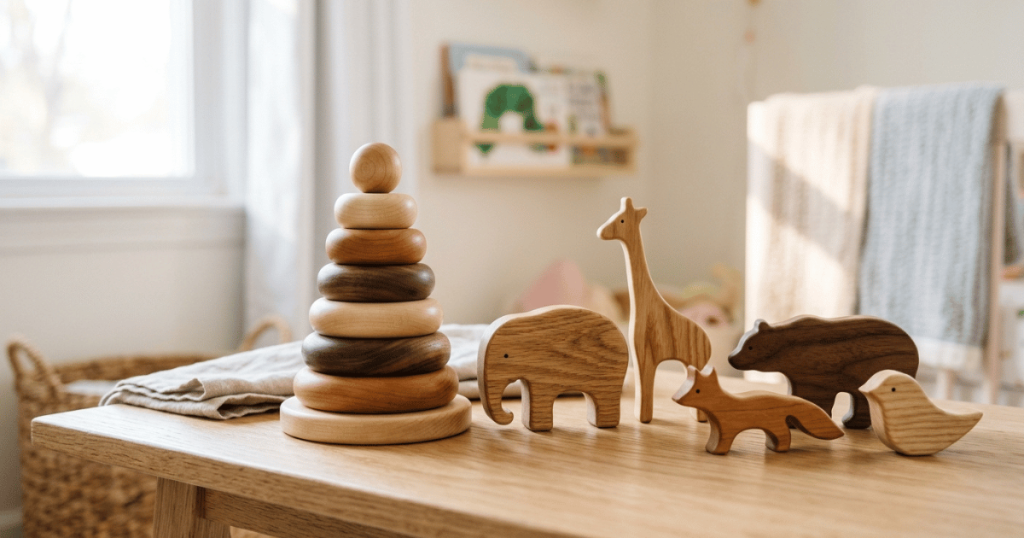
Weight, texture, size, and the sound pieces make when they touch all contribute to how a wooden toy feels in a child’s hands. A dense maple block feels noticeably different from a lightweight pine shape even if both are used for open-ended play.
That tactile quality is one of the things I enjoy about having wooden toys around our home.
Children rarely care whether a piece is technically beech or birch, but they certainly notice whether something is easy to hold, pleasant to touch, and satisfying to play with.
So, Which Wood Should a Parent Choose?
If you want a straightforward starting point, beech and hard maple are excellent all-around choices for durable wooden toys.
Birch deserves consideration too, particularly when the construction suits it. Rubberwood can offer a practical balance of durability, appearance, and resource use.
Pine and basswood should not automatically be rejected.
They are softer and will generally show wear more readily, but their lower weight and workability make them appropriate for certain designs.
The most useful question is therefore slightly broader than “What is the best wood?”
Ask what wood the toy uses, why that material makes sense for this particular design, how well the toy has been constructed, and whether the complete product suits your child’s age and way of playing.
That approach has been much more useful for me than searching for one perfect species.
Frequently Asked Questions
What is the best wood for children’s toys?
Beech and hard maple are excellent general-purpose choices because they are dense, durable, and capable of taking a very smooth finish. Birch and rubberwood can also be good choices, depending on the toy’s design and intended use.
What’s an appropriate wood type for making toy blocks?
Beech and hard maple work particularly well for blocks because they resist dents and everyday wear better than many softer woods. Whatever the species, blocks should be smoothly finished, appropriately sized for the intended age, and free from damaged or rough areas.
What is the best wood for baby toys?
Dense, fine-grained woods such as hard maple and beech are commonly used for baby toys. The complete toy still needs to be age-appropriate, with suitable dimensions, smooth construction, secure parts, and an appropriate finish.
Are wooden toys safe for kids?
A well-made, age-appropriate wooden toy can be a good choice for children, but the word “wooden” alone does not establish safety. Check the construction, surface condition, small parts, finish, age guidance, and any applicable safety information supplied with the toy.
Do wooden toys last longer?
Dense hardwood toys can last for many years when they are well constructed and cared for, which is one reason beech and maple are so common. Softer woods may collect dents and scratches sooner, while the quality of joints, finishes, and overall construction also has a major effect on longevity.