Quick Answer: Wooden toys are made around the world, including China, Indonesia, Germany, other parts of Europe, and several Asian manufacturing regions. A brand may be designed or headquartered in one country while its toys are manufactured somewhere else, so the individual product’s country-of-origin information is the best place to check.
Wooden Toys Do Not Come From One Main Country
When we picture traditional wooden toys, it is easy to imagine a small European workshop with someone cutting and painting each piece by hand. Those workshops still exist, but they represent only one part of today’s wooden toy industry.
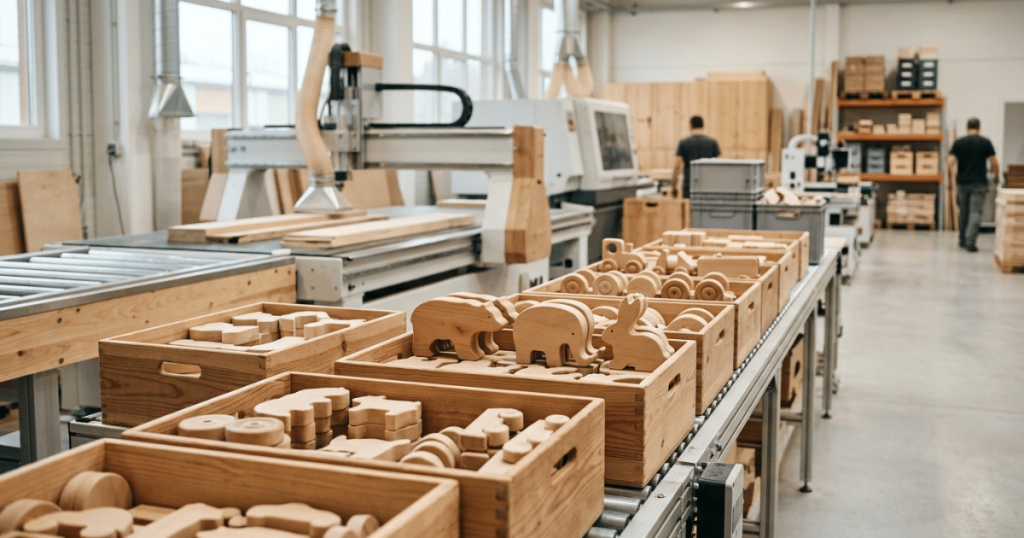
Modern wooden toys come from both large factories and smaller specialist workshops around the world. China and Southeast Asia have extensive manufacturing capacity, while Germany and other European countries continue long traditions of local wooden toy production.
The brand name on the box does not necessarily tell you where the toy was made.
This was something I paid much more attention to after becoming a parent. I once picked up a brightly painted wooden play piece for my daughter and assumed the European-looking brand meant European manufacturing, only to find a different country listed in tiny print on the packaging.
That was when I started separating three questions: Where is the company based? Where is the toy designed? Where is that particular toy manufactured?
The answers can be completely different.
Why So Many Wooden Toys Are Made in Asia
China has a huge toy manufacturing industry, including factories that specialize in wooden puzzles, Montessori-style materials, pretend-play sets, blocks, and other educational toys. The country has suppliers serving markets throughout North America and Europe.
Southeast Asia is important too.
One reason is access to established manufacturing infrastructure. Factories can handle woodworking, painting, assembly, packaging, and large international orders within developed supply chains.
Another is the availability of materials such as rubberwood in parts of Asia. Rubberwood comes from rubber trees that were originally grown for latex production. Once those trees are no longer productive for latex, their wood can be used for products such as furniture and toys instead of simply being discarded.
For parents, “made in Asia” therefore tells only part of the story. Two toys manufactured in the same country can differ greatly in materials, finish, factory oversight, and quality control.
Tender Leaf Shows How Design and Manufacturing Can Cross Borders
Tender Leaf is a particularly clear example of how a modern wooden toy supply chain can work.
The brand describes its toys as dreamed up in England and made in Indonesia. Its toys are produced by Mentari International, a family-run factory in Indonesia, using reclaimed rubberwood from the latex industry.
The manufacturing process is unusually easy to trace because Tender Leaf explains that the stages from raw timber through production take place under one roof. Pieces are eventually hand-painted, assembled, checked, and packaged there.
Tender Leaf also says its toys meet EN71, ASTM F963, and ISO safety standards, and that its supply chain has received ICTI Ethical Toy Program approval.
So calling Tender Leaf simply a “British toy” or an “Indonesian toy” misses useful context.
It is a British-designed brand with manufacturing carried out in Indonesia.
Bigjigs Shows Why You Should Check Individual Products
Bigjigs has British roots going back to 1985, when Peter Ireland began making wooden jigsaw puzzles in a garden shed in Kent. Today its toys are designed and illustrated at the company’s headquarters in Folkestone.
Manufacturing is broader.
Bigjigs says it works with production facilities in the Far East, while its supply-chain statement describes factories across Southeast Asia, North America, and Eastern Europe. The company also says many of its toys use rubberwood.
That makes Bigjigs a good reminder that one brand does not always equal one manufacturing country.
If country of origin matters to you, check the specific toy rather than assuming that every Bigjigs item was made in exactly the same place.
What About Janod?
Janod is a French brand, and its visual identity can understandably make parents associate its toys with France.
Manufacturing origin should still be checked product by product rather than inferred from the brand’s nationality.
Janod’s own materials information says it is increasingly using FSC-certified wood and cardboard. It also says paints and varnishes used on its toys are laboratory tested according to applicable standards, with water-based paint preferred for some early-learning toys intended for children under three.
That distinction is useful because “French brand,” “FSC-certified material,” and “made in France” describe three different things.
A company’s headquarters tell you where the business comes from. Material certification tells you something about sourcing. The country-of-origin label tells you where that particular product was manufactured.
Some Wooden Toys Really Are Still Made in Germany
Local European wooden toy manufacturing has not disappeared.
HABA says it produces wooden toys using locally sourced beech wood in Germany. Its German-made range includes grasping toys, stacking toys, motor-skills products, games, and other wooden items.
At the same time, even HABA demonstrates why brand-level assumptions can be misleading. Its US information says most of its wooden toys and board games are made in Germany, while it also partners with suppliers in China for products including plush toys, dolls, plastic toys, and other items.
Other smaller German manufacturers continue local production as well.
So if you specifically want a wooden toy made in Germany or another particular country, those products certainly exist. You simply need to verify the actual item.
Does the Country of Origin Tell You Whether a Toy Is Good?
I would never use country of manufacture as my only quality test.
A more useful starting point is the toy itself. Look at how smoothly the wood has been finished, whether pieces feel secure, whether the toy is appropriate for your child’s age, and whether the manufacturer provides clear safety and material information.
When my son was four, I had two wooden vehicles from different brands sitting in the same toy basket. He had no interest in which countries were printed underneath them, but I noticed immediately that one had a much smoother axle and better-finished edges after months of being pushed across our kitchen floor.
That kind of everyday use taught me to look beyond the label on the front of the box.
Country of origin can still matter to a family for environmental, economic, ethical, or personal reasons. It just should not be treated as an automatic quality grade.
What Does “Ethically Made” Actually Mean?
“Ethically made” sounds reassuring, but it is worth looking for details behind the phrase.
A company might explain how it selects and monitors factories. It may disclose where the wood comes from, describe working conditions, or participate in recognized ethical supply-chain programs.
Tender Leaf, for example, publicly identifies its Indonesian manufacturing partner and discusses worker training and wellbeing at the family-run factory. It also states that the factory provides employment to hundreds of local villagers.
Bigjigs says its production facilities are regularly visited and that it expects suppliers to meet its ethical standards. Its anti-slavery statement also describes efforts to monitor risks throughout its supply chain.
Specific information is more useful than a vague green or ethical claim.
Wood Origin and Toy Origin Are Different Questions
There is one more distinction parents can easily miss.
A toy might be manufactured in one country using wood grown somewhere else. Even when manufacturing is local, the origin and certification of the timber are separate parts of the supply chain.
This is why labels such as FSC can be useful. FSC certification relates to responsible forest management and the chain through which forest-based materials reach products. It does not mean the finished toy was manufactured in the same country where the tree grew.
Reclaimed rubberwood is another example. Brands such as Tender Leaf use rubberwood that has already served a purpose in latex production before the timber becomes material for toys.
So a thoughtful purchase can involve more than asking where the factory is located.
How I Check Where a Wooden Toy Was Made
For a toy already in my hands, I start with the packaging or the product itself.
Look for wording such as “Made in,” “Country of Origin,” or similar manufacturing information. For an online purchase, check the manufacturer’s product page and packaging photographs when available.
If the brand only says “Designed in Britain,” “Designed in France,” or “European design,” do not assume that statement identifies the manufacturing country.
I also like brands that explain their materials and production openly.
You do not need to investigate an entire global supply chain every time your child needs a puzzle. A clear country-of-origin label, sensible safety information, appropriate age guidance, and transparent material details can tell you far more than marketing language alone.
Frequently Asked Questions
Are most wooden toys made in China?
China is a major producer of wooden toys, but wooden toy manufacturing also takes place in Indonesia, Germany, other parts of Europe, and elsewhere. The exact country depends on the brand and product.
Where are Tender Leaf wooden toys made?
Tender Leaf says all of its toys are made by Mentari International in Indonesia. The brand uses reclaimed rubberwood and describes its toys as designed in England and crafted in Indonesia.
Where are Bigjigs wooden toys made?
Bigjigs is based in England and designs its toys at its UK headquarters, but it works with manufacturing facilities in multiple regions. Its supply-chain information includes production across Southeast Asia, Eastern Europe, and North America, so check the individual product for its specific country of origin.
Does made in China mean a wooden toy is low quality?
No. Manufacturing country alone does not establish the quality of a toy. Materials, construction, finishes, safety compliance, factory oversight, and quality control are more useful things to examine.
How can I tell where my wooden toy was manufactured?
Check the toy, packaging, or manufacturer’s information for a “Made in” or country-of-origin statement. Do not assume that the company’s home country or a “Designed in” statement is also the manufacturing location.