Quick Answer: Wooden toys for small spaces and travel should fit their storage container, need little room during play, and be easy to put away. Check their weight and age suitability as carefully as their dimensions, because a miniature set can still be heavy or contain unsuitable small parts.
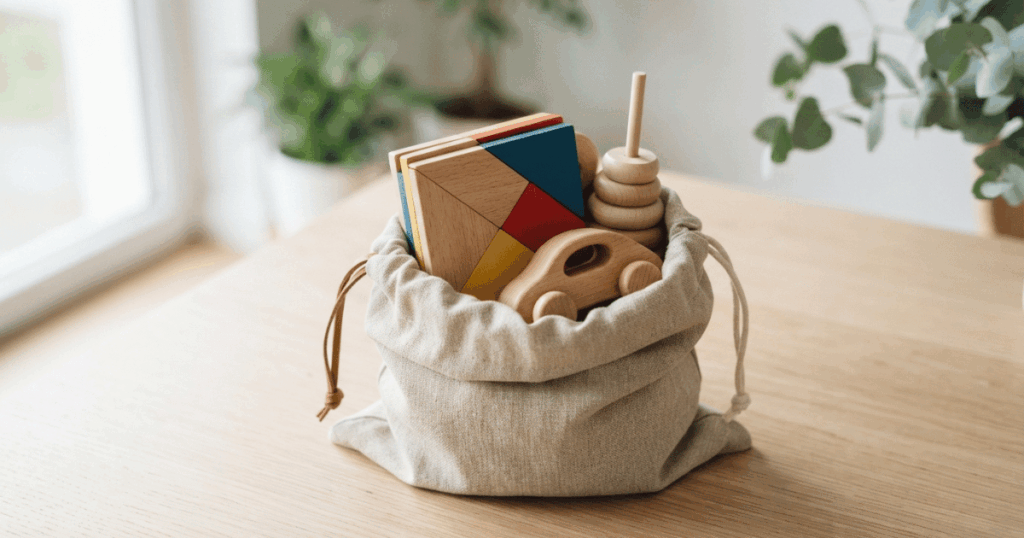
Start with the space where your child will actually play
A toy can fit neatly inside a backpack and still take over an entire table once opened. A compact building set might need room for a growing construction. A puzzle needs somewhere to place its loose pieces while your child works.
Packed size is only half the decision.
Before choosing a toy, picture the available surface. At home, that might be one end of the coffee table. Away from home, it could be a small table at a relative’s house where drinks and plates also need space.
We can make this practical by marking out the available area with a sheet of paper. Try an existing toy within that boundary and notice what spills beyond it. This simple check can reveal whether your child needs a contained activity or has enough room for building.
Also consider whether the play depends on a stable surface. A balancing activity that works well at home may become frustrating on a moving train.
Small-space storage and travel packing have different demands
At home, a slightly heavier toy may be perfectly manageable if it lives on a low shelf. In a day bag, the same weight competes with everything else you carry. A sturdy storage box can also add noticeable bulk.
For travel, lift the complete packed set before deciding it is portable.
A useful home container should be easy for your child to access and put away. A travel container also needs to stay closed when tipped sideways. An open basket solves the first problem but does little to prevent pieces from escaping inside a bag.
Check the container rather than relying on the word “compact.” Does the lid remain secure? Can all the pieces fit without a careful packing arrangement that only an adult can manage?
A toy that is awkward to repack becomes your job at every stop.
Look for useful design features rather than miniature size
Different formats solve different space problems. The aim is to match the design to your available room and your child’s interests.
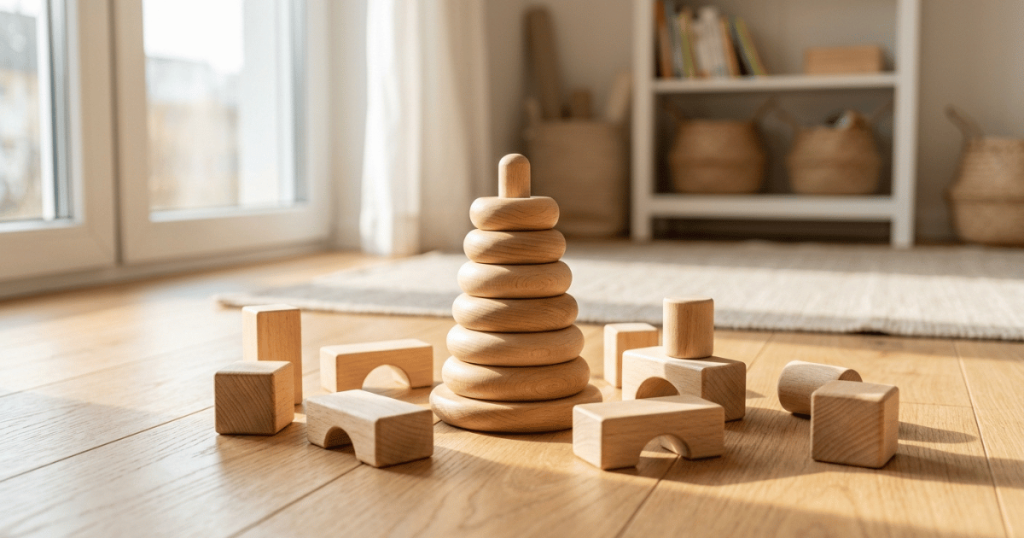
Nesting pieces
Nesting pieces fit inside one another, reducing their stored footprint. However, they may spread across a larger area when arranged separately. Check both layouts before assuming they suit a narrow play corner.
They should also be straightforward to put back together.
Flat boards with retained pieces
An activity board whose pieces remain securely attached can simplify cleanup. It may offer a contained way to practice hand movements without scattering loose components. Check how far handles or other fittings project from the board, since a flat-looking toy may still be bulky.
Inspect the moving parts and follow the stated age guidance.
Small building collections
A limited selection of blocks can support open-ended play, where the child decides what to create. Arranging pieces gives children opportunities to practice hand-eye coordination and problem-solving. The useful question is whether the available shapes support the kind of building your child enjoys.
Miniature pieces require separate attention to age suitability.
Games with integrated storage
Some games store their pieces inside the playing board or case. This can reduce the number of separate containers you need. Before packing one, check whether the game needs more table space than its closed box suggests.
Count the pieces you will need to manage
A compact set with dozens of loose parts can create more work than a larger toy with one movable section. Piece count affects setup and cleanup as well as the chance of leaving something behind. Consider what happens if a single component disappears.
Some toys remain useful with one piece missing; others become incomplete immediately.
We can test this before a trip by setting the toy up on a small table and packing it away again. Notice whether pieces roll off or hide beneath the container. If cleanup is already awkward at home, a crowded waiting area is unlikely to make it easier.
For sets with loose pieces, keep a simple count inside the container. A photograph of the complete contents can also make repacking easier without requiring a particular arrangement.
Avoid combining several activities in one large pouch. Separate containers make it easier to bring out one activity and return it before opening another.
Keep age suitability ahead of convenience
Travel-friendly should never mean choosing pieces that are too small for the child using them. Follow the manufacturer’s age guidance and read any small-parts warning. A toy intended for an older sibling should remain separate from a younger child’s play materials.
Close supervision does not make an unsuitable toy age-appropriate.
In a shared room, think about where pieces may end up after play. An older child’s small counters can slip beneath furniture and become accessible later. Count them back into their container before the younger child returns to that space.
Also check condition before packing. A loose wheel or damaged joint deserves attention even when the main toy still looks sturdy.
Give a small collection more room to work
In a small home, start with the storage space you genuinely have. If one shelf is available, choose a collection that fits there comfortably. Leaving a little room makes it easier for your child to return toys without emptying everything first.
Storage should support play rather than become another daily puzzle.
Toy rotation can reduce what is on display, but the remaining toys still need a home. Decide where that reserve collection will live before relying on rotation to solve overcrowding. Otherwise, the clutter simply moves into a cupboard.
There is no need to follow a fixed rotation schedule. Keep an activity available while your child is using it, and change the selection when interest fades or the room needs a different setup.
At home, we can also vary the invitation instead of adding more pieces. A few blocks beside a drawing of a road create a different starting point from the same blocks arranged for a tower.
Pack around the journey, not an ideal play session
A day out usually contains different kinds of waiting. Some moments allow a table and a longer activity. Others leave space only for a brief interaction while your child stays beside you.
Pack for the conditions you expect.
A loose-piece game may suit a stationary table but be inconvenient while boarding transport. Keep activities that need setup for moments when you can stop and manage them comfortably. Avoid opening several containers at once.
For a moving car, choose activities suited to that setting and follow relevant restraint guidance. The driver should not need to retrieve dropped pieces. A favorite wooden toy can wait until arrival if using it during the journey would create distraction.
Finally, try the packed selection at home. Your child’s response will tell you more than a promise that one small toy can entertain them for an entire holiday.
Frequently Asked Questions
What makes a wooden toy suitable for a small home?
It should fit its storage space and work within the area available for play. Easy cleanup matters too, especially when the room serves several purposes.
Are miniature wooden toys suitable for toddlers?
Not automatically. Check the stated age range and small-parts warnings rather than judging suitability from the material or appearance.
How many toys should we pack for a trip?
Start with a small selection your child already enjoys and consider the length and conditions of the journey. There is no fixed number that suits every family.
Can the same wooden toys work at home and away?
Yes, if their weight and storage design suit both settings. A toy that works on your living-room floor may still need too much space for a small travel table.
How can we avoid losing wooden puzzle pieces while traveling?
Use a securely closing container and bring out one activity at a time. If keeping loose pieces together is difficult, save that puzzle for a stationary play area.