Quick Answer: Before buying a wooden toy, check its age guidance, manufacturer information, and suitability for your child’s current abilities. Then consider its construction and care instructions, followed by whether it adds something useful to the toys you already own.
Begin with your child’s current play
The first purchase can feel surprisingly important. Product descriptions promise learning opportunities, while photographs make a complete wooden playroom look like the starting point. You can begin with much less.
Watch what your child already enjoys doing.
A child who repeatedly puts objects into a container may enjoy an age-appropriate toy built around placing and removing pieces. Another child may prefer rolling something across the floor. These observations give us a more useful starting point than choosing a toy because it appears on a nursery checklist.
Keep the age label as a separate requirement. Interest in an older child’s activity does not make its smaller pieces suitable for a younger child.
We can choose for the present without planning the entire next stage.
Your wooden toy checklist before buying
Use these checks while reading the product description. If essential information is missing, ask the seller before ordering.
1. Is the age guidance clear?
Look for a stated age range and read any warnings that accompany it. Age guidance addresses safety as well as the skills involved in using the toy. A child being quick to learn does not remove a small-parts hazard.
Avoid guessing from photographs.
Also consider younger children who may share the space. An older sibling’s toy needs suitable storage if its pieces could become accessible to a baby.
2. Can you identify the manufacturer and product?
Check for a named manufacturer or responsible supplier. The listing should make it possible to identify the exact toy rather than showing only a general description. Keep the model details and purchase record after it arrives.
This information matters if you later need instructions or discover a recall.
A marketplace seller’s name alone may not tell you who made the product. If the description is unclear, request those details before buying.
3. Are there small or detachable components?
Look beyond the main wooden body. A large vehicle may still have detachable wheels, and an activity board may include smaller fittings. Small parts are a particular choking concern for children under three.
Follow the product’s warnings rather than relying on supervision to compensate for an unsuitable age range.
For young children, avoid toys with accessible button batteries or loose powerful magnets. A wooden exterior does not remove the hazards of components inside it.
4. Is the construction suitable for normal play?
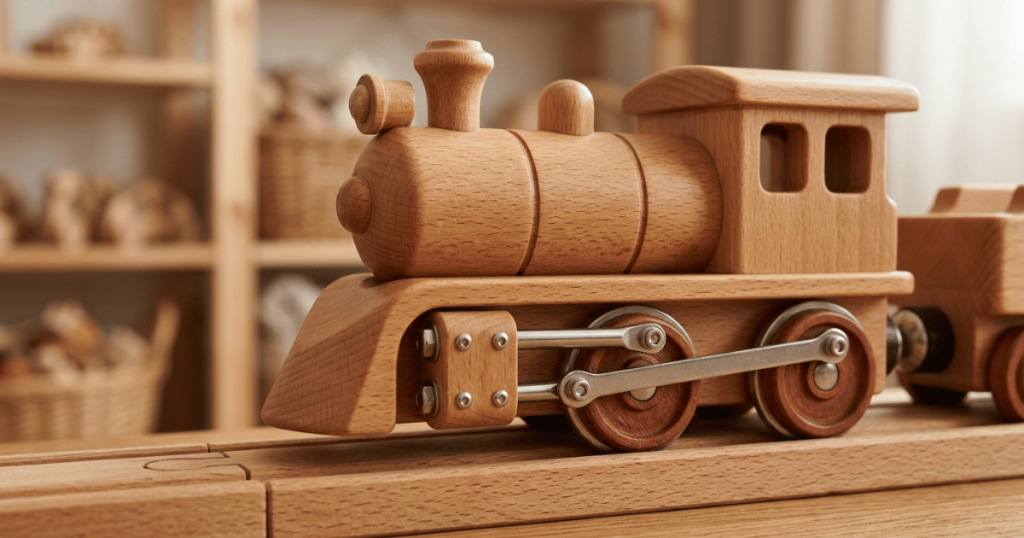
Look for clear photographs of the actual toy, including its underside where possible. Check how movable parts attach and whether the design includes narrow sections that could be vulnerable to damage. Reviews may reveal recurring faults, although they cannot establish safety compliance.
Once the toy arrives, inspect it before handing it over.
A rough edge or loose fitting deserves attention immediately. Remove damaged toys from play rather than assuming a child will avoid the affected area.
5. Is there useful information about the finish?
“Natural” describes very little on its own. Look for information about the coating and whether the finished product is intended for children in the stated age group. A water-based description alone does not establish that a paint is suitable for toys.
You cannot verify chemical safety by touching or smelling a surface.
Likewise, an unpainted toy still needs appropriate construction and materials. Treat appearance as a preference after the essential checks.
6. Are the care instructions practical?
Read the cleaning instructions before purchasing. Different coatings and construction methods can require different care. A toy that needs careful wiping may be inconvenient if you expect frequent cleaning.
We should be able to care for it as directed.
Check whether it must be kept dry and whether any components require separate attention. Do not assume a wooden toy can be soaked or disinfected using any household product.
Choose a manageable first collection
There is no required number of wooden toys for a baby or toddler. Start with a small selection that offers activities your child can already explore. Leave room to learn what holds their interest before adding more.
One thoughtful purchase can be enough for now.
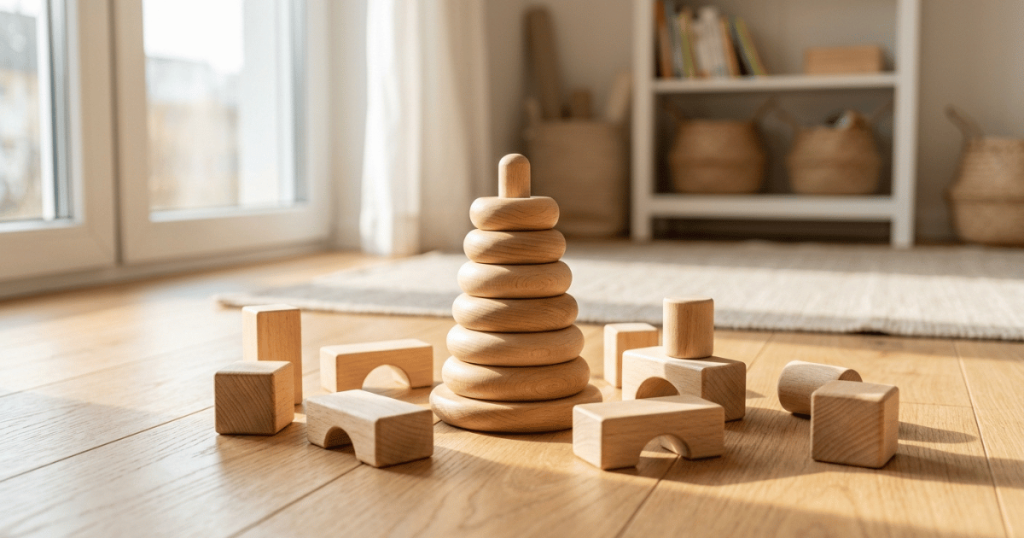
For example, an age-appropriate set of large blocks might invite placing and stacking. Those actions provide opportunities to practice fine motor skills, the smaller hand movements used to handle objects. As play develops, the same pieces may become part of a pretend scene.
A puzzle offers a different kind of activity. Turning a piece to fit its opening involves hand-eye coordination and problem-solving, but the challenge should remain approachable. Repeated frustration can be a reason to put it away temporarily rather than buy another similar puzzle immediately.
These possibilities depend on the child and the design, not simply on the toy being wooden.
Check the practical fit for your home
Before ordering, decide where the toy will live. Measure the assembled size if it needs floor space. A compact product photograph can hide a surprisingly large frame or base.
Include space for play as well as storage.
Check the listed weight, especially if the toy is intended to be lifted or carried by the child. A substantial object may feel durable to an adult while being awkward for a small child to manage. Consider where it might fall during normal use.
We can also check whether cleanup is realistic. A container that requires precise packing may mean an adult has to put every piece away. A simpler arrangement makes it easier to involve your child when they are ready.
Set your budget before comparing extras
Price can reflect several things besides play value. A decorative finish or elaborate presentation box may increase the cost without changing the activity. Decide what you can comfortably spend before comparing those details.
An expensive toy is not a developmental requirement.
Look at what the purchase adds. If you already have a suitable stacking activity, another version may offer little that is new. Waiting gives you time to notice a different interest instead of building a collection around repeated functions.
For larger purchases, check whether spare parts are available. A replaceable wheel can make a difference to future usefulness, although replacement availability should never excuse a fault in a new toy.
Make one final check when it arrives
Keep the packaging until you have checked the contents and instructions. Confirm that the delivered model matches what you ordered. Complete any required assembly before introducing the toy.
Set it up away from your child first.
Inspect the surfaces and attachments without attempting destructive tests. If something appears damaged or inconsistent with the description, contact the seller and keep the toy out of use. Do not sand or repaint a new faulty toy as a substitute for resolving the problem.
When everything is ready, offer a brief invitation to play. Demonstrate one simple action if useful, then give your child time to respond. The purchase creates an opportunity for play; your attention helps make that opportunity meaningful.
Frequently Asked Questions
What should I check first when buying a wooden toy?
Start with the age guidance and warnings, then confirm who made the toy. If that information is missing, resolve it before considering appearance or educational claims.
Are wooden toys automatically safer than plastic toys?
No. Safety depends on the finished product, including its construction and components, rather than the main material alone.
How many wooden toys do first-time parents need?
There is no required number. Begin with a manageable selection suited to your child’s current interests and add more when you see a genuine reason.
Should I buy toys for the next age stage in advance?
You can wait until your child is closer to using them. If you buy ahead, store unsuitable toys securely and continue to follow their age warnings.
Does an educational label mean a toy is worth buying?
The label alone tells you little about how your child will use it. Look for a clear activity that suits their abilities and leaves room for enjoyable interaction.