Quick Answer: To encourage kids to play with wooden toys, connect an age-appropriate toy to something they already enjoy and make it easy to start. Join them briefly if invited, then leave room for their ideas without requiring them to use the toy in a particular way.
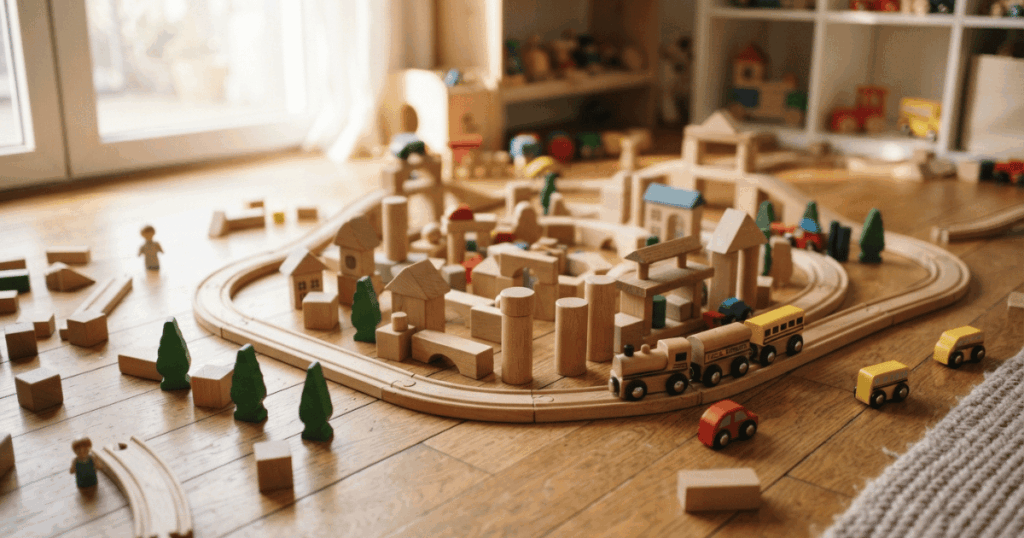
First, work out what your child is choosing instead
An untouched wooden toy can feel disappointing, especially when you chose it carefully. Before changing the playroom, notice what your child reaches for instead. The useful clue may be the activity rather than the material.
A plastic truck might be appealing because its loading door opens.
Your child may enjoy filling it and tipping the contents out. A wooden vehicle without that feature offers a different experience, even if both are called trucks. Choosing the first one does not establish a general preference against wood.
The same applies to familiar characters. A child who carries a favorite figure everywhere might welcome a wooden block shelter for that figure. Starting with their existing story gives the unfamiliar toy a purpose.
We can use that interest without asking them to abandon something they love.
A step-by-step way to invite wooden toy play
Try these steps with a toy you already own. Change one thing at a time so you can notice what makes a difference.
Step 1: Check that the activity is manageable
Observe where your child stops. They may try to connect two track pieces, struggle with the fit, and leave. That is a different problem from looking at the track and showing no interest.
Check the toy on a stable surface.
If the connection is suitable but difficult, offer help with that one part when needed. Follow the age guidance, and put the toy aside if it is damaged or unsuitable. Making play easier should not involve removing safety features or introducing smaller pieces.
Step 2: Make the starting point obvious
A large mixed basket can hide the pieces needed for an activity. Set out a small, complete selection where your child can reach it. Keep enough space around it for comfortable play.
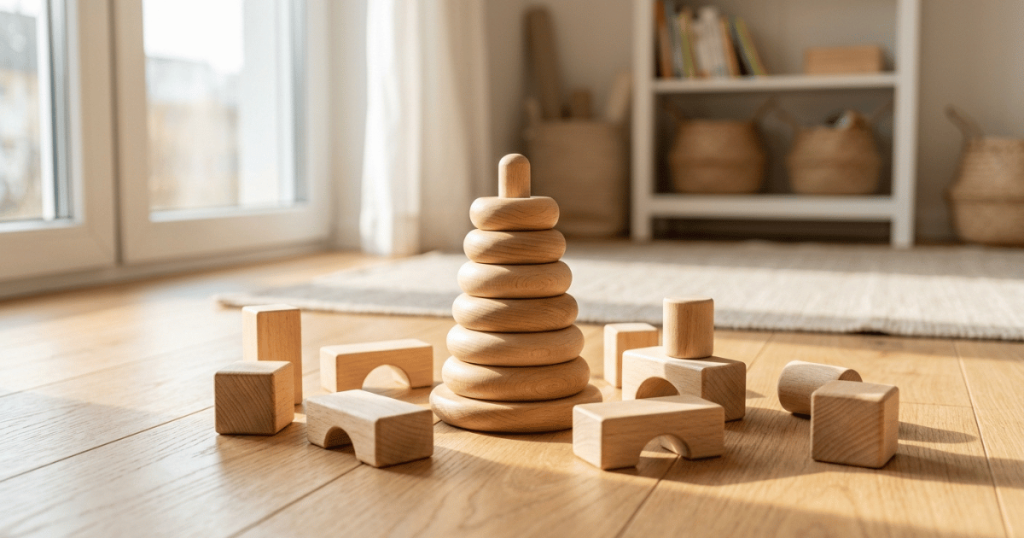
For blocks, this might mean a few useful shapes beside an empty building area. For a puzzle, place its pieces nearby rather than leaving them buried beneath unrelated toys.
The arrangement should be easy to explore.
Step 3: Add one familiar connection
Place an existing favorite beside the wooden toy if the combination is safe. A familiar vehicle can travel between block buildings. A doll might need a simple pretend bed.
Avoid preparing an elaborate scene that leaves little for your child to decide. A small starting point gives them somewhere to begin while keeping the next action open.
You do not need to buy extra accessories.
Step 4: Offer a brief invitation
If your child seems unsure, show one possible action. Roll a wooden car through a block opening or place a figure inside a simple enclosure. Then pause and see what happens.
A demonstration is a starting suggestion.
If your child turns the enclosure into a shop, follow that direction. Rebuilding your original scene or explaining the “correct” story can make your idea more important than theirs.
Step 5: Respond without taking over
When invited into play, let your child assign your role. You might hold a piece steady or become the customer in a pretend shop. Wait before adding another instruction.
Use a comment when it helps the interaction.
“The car fits underneath” acknowledges what happened without requiring an answer. Repeated questions about colors or numbers can shift a relaxed activity into a test.
Step 6: Leave room for independence
If your child becomes absorbed, reduce your involvement gradually. You can remain nearby without providing the next idea. Keep supervision appropriate to their age and the activity.
Do not measure success by how quickly you can leave.
A child may enjoy a brief shared activity before moving on. That still tells us something about how to introduce the toy next time.
Let the toy be used in unexpected ways
Adults often associate a toy with the picture on its box. A child may see something else entirely. Wooden rings might become pretend food during an age-appropriate game, while blocks might form a long road instead of a tower.
Allow safe variations.
Open-ended play means the activity can develop in more than one direction. It does not require a child to invent a detailed imaginary world. Repeatedly arranging pieces can be a satisfying form of exploration too.
These actions offer different opportunities. Placing a block carefully involves fine motor skills, the small hand movements used to handle objects. Adjusting a bridge so a vehicle fits underneath brings in problem-solving and hand-eye coordination.
We can leave those opportunities within the play without naming a lesson every time.
Check whether the environment is getting in the way
A child may ignore a toy because using it involves too much setup. A train set stored in several difficult containers is less accessible than a vehicle already on the floor. A construction that repeatedly collapses on thick carpet can also become frustrating.
Remove the practical obstacle first.
Try a suitable flat play surface or keep the essential pieces together. Avoid rearranging everything while your child is still using it. An unfinished creation may be something they intend to return to.
Timing matters as well. A tired child may want familiar comfort rather than a new building challenge. Offer the activity again at a calmer moment without treating the earlier refusal as failure.
Use toy rotation as an experiment
Putting some toys away can make the remaining choices easier to see. However, storage does not change the difficulty or appeal of an activity. A puzzle that was too challenging may need more time, regardless of how long it disappears.
Rotate in response to what you observe.
Keep a well-used toy available while it remains part of your child’s play. If another has been ignored, put it aside and later offer it with a simpler setup. There is no need to follow a strict weekly schedule.
When reintroducing it, watch for a genuine change in interest. Repeatedly presenting an unwanted toy with increasing enthusiasm can become pressure.
When encouragement is not helping
You may try a manageable setup and join in warmly, yet your child still chooses something else. That is useful information. A toy can be well made and simply not suit this child at this time.
You do not have to recover its purchase price through play.
Avoid rewards for using wooden toys or removing all other materials to force the choice. A mixed collection can support different activities, and material alone does not determine play value.
If your child outgrows the toy without enjoying it, consider passing it on in suitable condition. Future purchases can follow the interests you have observed rather than the collection you originally pictured.
Frequently Asked Questions
Why does my child prefer plastic toys to wooden toys?
They may prefer a particular feature or familiar character rather than plastic itself. Watch what they do with the preferred toy before deciding that the material explains their choice.
Should I remove other toys to encourage wooden toy play?
You can simplify the available selection without removing every alternative. Avoid making access to favorite toys conditional on using wooden ones.
How do I introduce wooden blocks to a child who ignores them?
Connect a few age-appropriate blocks to an existing interest, such as making a space for a favorite vehicle. Offer one simple starting idea, then let your child change it.
Does getting bored with wooden toys mean my child lacks imagination?
No. The activity may be unfamiliar or poorly matched to their current interests. A brief period of play does not measure a child’s imagination.
What if my child still does not want to play with the toy?
Put it aside and try again later if it remains suitable. If interest never develops, it is reasonable to stop offering it and choose future activities based on what your child enjoys.