Quick Answer: Yes, wooden toys can splinter if their surfaces are poorly finished or the wood becomes damaged. Remove a toy from play if you find sharp fibers, a split, or a broken edge, and seek manufacturer guidance before considering a repair.
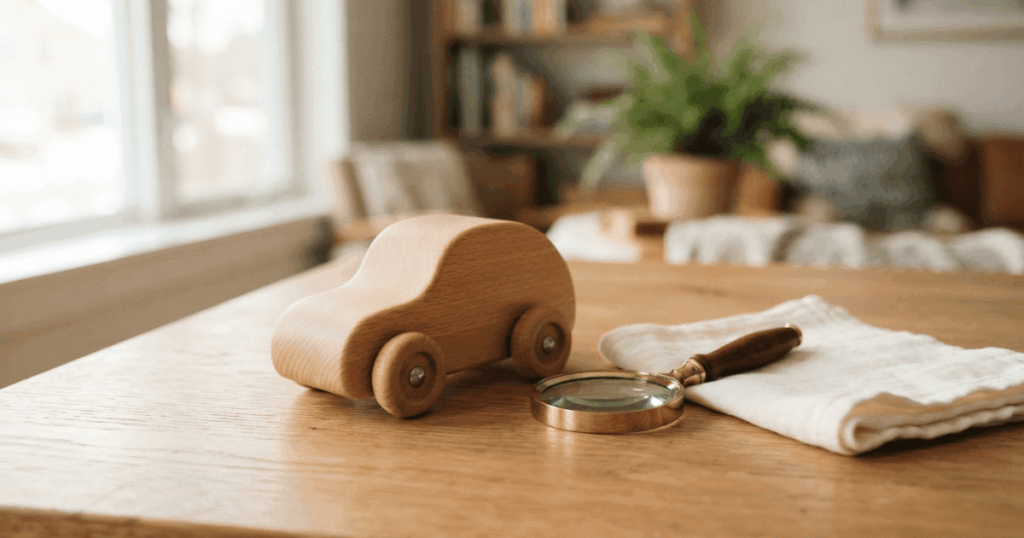
A smooth new toy can still develop damage
Wooden toys should arrive with smoothly finished surfaces. You should not need to remove sharp fibers before a child can use a new purchase. If a toy feels unfinished in a way that could hurt someone, contact the seller rather than treating it as routine preparation.
Splinters are not an acceptable feature of natural wood.
Even a well-made toy can change with use. A hard impact may chip a corner, while damage around a narrow section can develop into a split. The important question is whether the toy remains sound now, rather than whether it looked sturdy when you bought it.
For example, a wooden vehicle may still roll after the edge around its axle has cracked. That movement does not tell us the damaged area is safe. We need to inspect the wood itself.
Why wooden toys may splinter
Several factors can contribute to a rough or damaged surface. They may overlap, so appearance alone will not always reveal the cause.
Incomplete surface preparation
Sanding removes roughness during production, and careful finishing includes areas beyond the main visible face. The inner edge of a shape-sorter opening needs attention just as much as the outside. A painted surface can also hide an area that becomes noticeable only after wear.
Good sanding quality matters, but it is one part of the finished product.
Impacts and repeated wear
A dropped toy can land on an exposed corner. Repeated knocks may also damage a thin projection or the wood around an attachment. A dent does not always mean a toy has splintered, but a lifted shard or sharp broken edge needs immediate attention.
We should look more closely after an obvious damaging impact.
Moisture and unsuitable care
Wood responds to moisture, and its surface can change after wetting and drying. Depending on the construction, prolonged wetness may also affect joints or glued layers. This is one reason care instructions matter.
Do not assume a wooden toy is suitable for soaking because it needs cleaning.
Follow the manufacturer’s directions for the specific product. If a toy has become swollen or started separating, drying it does not automatically restore its original condition.
Tell surface texture from actual damage
Visible wood grain is normal. The grain is the pattern created by the wood’s fibers, and a smooth surface can still show it clearly. Color variation alone is not a splinter.
Sharpness is a different matter.
Look for a thin piece lifting from the surface or a jagged edge where material has broken away. A crack may appear as a narrow line that runs into the wood. Peeling paint is another problem, even when no wooden shard is visible.
If you cannot tell whether a line is harmless grain or a developing split, keep the toy aside while you ask the manufacturer. A clear photograph can help explain the area without repeatedly handling it.
There is no need to press a bare hand along a suspicious edge to prove that it is sharp.
Inspect the places children actually touch
A quick glance at the painted front can miss damage elsewhere. Turn the toy over in good light and examine every accessible side. Pay particular attention to areas a child grips or puts in their mouth.
Start with these places:
- Corners and exposed ends.
- Handles and narrow projections.
- The edges of holes and cutouts.
- Wood around wheels or other attachments.
- The exposed edges of glued layers.
Look without forcing joints apart or bending pieces to test them. Home inspection can identify visible damage, but it cannot establish that a product meets all safety requirements. If an attachment is loose, the concern may extend beyond the surface finish.
We can make this check part of putting toys away. Also inspect after an unusual impact or when cleaning reveals a change in the surface.
What to do when you find a splinter
Remove the toy from play first. Put it somewhere children cannot access, rather than returning it to the usual toy basket. That prevents someone else from offering it before the issue has been resolved.
Then identify the product.
Keep a photograph of the damage and contact the manufacturer or seller with the model details. Explain whether it arrived that way or changed during use. Check for recall information when you can identify the exact product.
For a new toy, request a suitable resolution before attempting alterations. Sanding it yourself can obscure the original defect and leave you responsible for assessing a repair you did not need to make.
For an older toy, ask whether the damaged component can be replaced. Replacement may be more appropriate than trying to preserve a weakened piece.
Sanding does not solve every kind of damage
Sanding can remove material from a surface. It cannot, by itself, restore the strength of cracked wood or secure a loose joint. Making an edge feel smoother may leave the underlying problem unchanged.
That distinction matters most around parts under stress.
Consider a split beside a wheel axle. Smoothing the outer edge does not establish that the axle will remain attached during play. Similarly, sanding a peeling layered board may leave more material exposed without resolving the separation.
Follow product-specific repair guidance rather than a universal sandpaper recommendation. There is no single grit number that makes every damaged toy safe.
Do not sand an old painted toy with an unknown finish as a routine home fix. Obtain appropriate advice about the coating before disturbing it, especially if the toy’s age or origin is unclear.
Wood type and coatings cannot guarantee a splinter-free toy
Some woods are commonly chosen for their durability and machining qualities. However, the species name does not tell you whether an individual toy was well designed or properly finished. A substantial block and a thin decorative projection can behave differently even when made from the same wood.
Check the complete product.
A coating may help protect a surface, but it cannot make damaged wood structurally sound. Oil or wax is also not a repair for a split. Only apply maintenance products when the toy’s manufacturer recommends them for that particular finish.
The same approach applies to unpainted toys. They still need appropriate construction and a smooth surface before use.
Reduce avoidable wear without overcomplicating care
Use the toy in the setting it was designed for. An indoor wooden puzzle may not tolerate being left on a wet patio. A toy intended for dry play should not become a bath toy unless its instructions specifically allow that use.
Keep care simple and product-specific.
After cleaning, follow the stated drying directions before storage. Avoid improvised maintenance treatments that could change the coating or affect glued parts. If the surface changes despite following the instructions, stop using it and ask for advice.
We do not need to treat every scratch as a ruined toy. We do need to distinguish ordinary cosmetic wear from damage that creates a sharp edge or weakens a component.
Frequently Asked Questions
Can good-quality wooden toys still splinter?
Yes. Good construction reduces avoidable problems, but impacts or other damage can change a toy’s condition. Inspect it when you notice wear or after an incident that may have damaged it.
Should a new wooden toy need sanding?
A new toy should arrive ready for its intended use. If you find sharp fibers or an unsafe edge, keep it away from your child and contact the seller.
Does oiling prevent wooden toys from splintering?
Oil is not a guarantee against splintering and cannot repair cracked wood. Use it only when the manufacturer recommends it for the toy’s finish.
Is a rough wooden toy safe for a baby to chew?
Do not offer a toy with sharp fibers or damaged surfaces for mouthing. Only use products intended for the child’s age and the stated activity, in sound condition.
When should a damaged wooden toy be replaced?
Replacement is appropriate when damage cannot be safely resolved through the manufacturer’s guidance or an approved replacement part. Keep a cracked or splintered toy out of play while deciding what to do.