Quick Answer: Store BRIO trains and tracks in manageable containers in a dry indoor location, with damaged pieces kept separately. If a wheel sticks, check for accessible hair or debris; if it is loose or broken, stop play and ask about model-specific service rather than gluing or forcing it back into place.
Sort the wheel problem before attempting a repair
“The wheel is broken” can describe several different problems. A carriage may drag because hair has wrapped around its axle. A powered engine may have wheels that turn but struggle to grip the track.
These situations need different responses.
First, identify whether you are handling a push-along vehicle or a powered engine. Powered mechanisms may resist movement differently, so do not force their wheels to behave like a free-rolling carriage. Check the instructions for the exact model.
Look for visible damage before cleaning. A cracked wheel or loose attachment needs a different decision from an otherwise intact axle with fuzz around it.
We can resolve some obstructions without taking the toy apart.
When a wheel sticks: check for accessible debris
Work away from children and switch a powered toy off. Follow its instructions for battery removal where appropriate. Place it on a clear surface where any loose material will be easy to see.
Then examine the gap around the wheel.
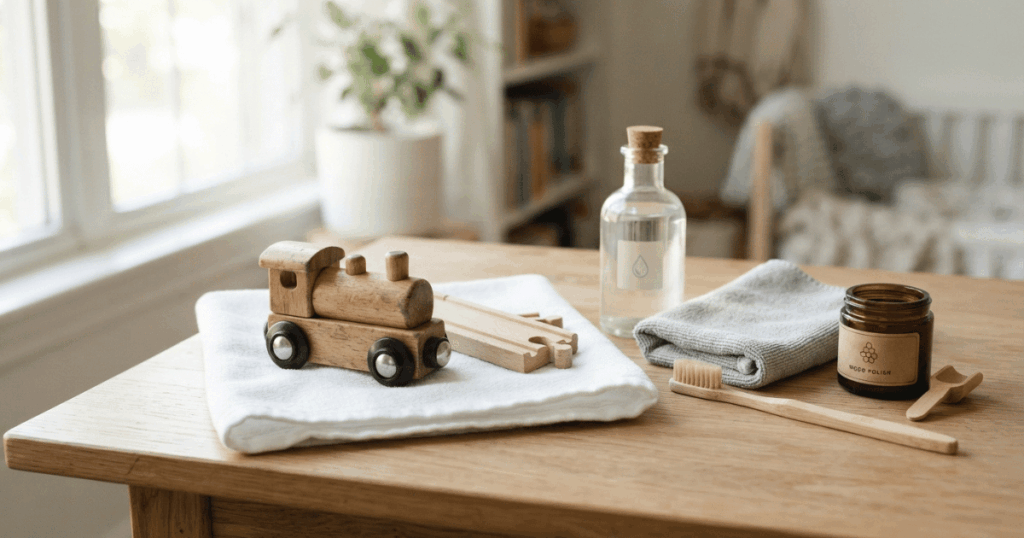
BRIO’s care guidance describes using tweezers or a toothpick to remove hair and fuzz around wheels or axles. Work gently on material you can reach without prying the assembly apart. Avoid pushing a tool deeply into the body or near electronic sensors.
Remove loose strands a little at a time. If the material will not come away without force, stop and seek guidance rather than pulling harder.
Afterward, check the movement appropriate to that model.
A manual carriage should roll without the obstruction that was causing it to drag. If it remains stiff, do not assume it needs oil. The cause may be inaccessible debris or damage that requires further advice.
A loose wheel needs more than a quick push
A wheel that wobbles unusually or starts coming away from its axle should be taken out of play. Pressing it back temporarily does not establish that its attachment is secure. The same applies to a wheel that has already detached.
Keep the wheel and vehicle together in a separate container.
Avoid adding glue to the axle as a general repair. It may interfere with rotation while leaving the original attachment problem unresolved. A wheel that appears fixed on the table may behave differently during ordinary play.
Do not substitute a screw or improvised fastener simply because it fits.
Identify the train and photograph the damaged area. Contact the original retailer or the relevant BRIO service team to ask what options exist for that model. A photograph of the underside markings can help distinguish similar-looking vehicles.
Some assemblies were not designed for repeated removal and refitting. Taking another wheel off to inspect its attachment can create a second problem.
Powered wheels can turn without moving the train properly
A powered engine that spins its wheels but does not move well may have a traction issue. Traction means the grip between the wheel surface and the track. Dust or damage can affect that contact, although the correct checks depend on the engine.
Start with its troubleshooting instructions.
Inspect accessible wheel surfaces and the track for visible debris. Follow the cleaning method specified for the model, especially where rubber tires or sensors are involved. Do not stretch or remove a tire unless the manufacturer provides that procedure.
Try the intact engine on a simple, level section of suitable track.
A problem that occurs only on one layout may involve the track connection or an incline. If the engine still struggles, describe the circumstances when requesting support. That information is more useful than immediately opening the motor housing.
Do not open tamper-resistant fasteners to investigate.
Build a storage system your child can use
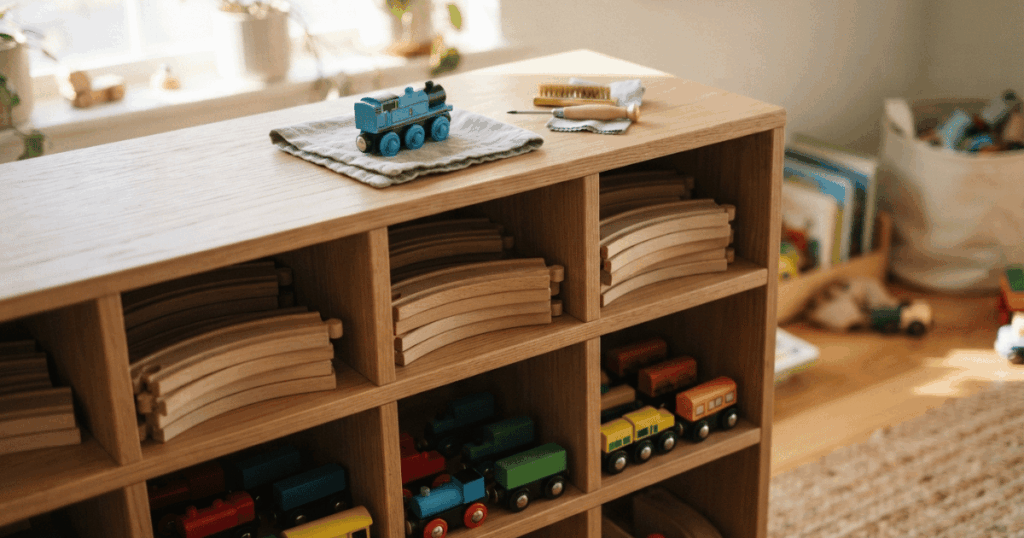
For everyday storage, begin with broad groups. Tracks can go in one container, vehicles in another, and larger scenery in a separate space. This keeps useful pieces findable without requiring every item to have an individual compartment.
Add more categories only when they solve a real problem.
A child who frequently builds long routes may benefit from separating straight and curved track. Another family may find that distinction adds unnecessary work. Watch what causes difficulty during setup before changing the system.
We can make labels practical with simple photographs. A picture of track on the track container helps a younger child participate without needing to read.
Choose containers that remain manageable when filled. A large box of wooden track can become heavy, even when each piece feels light.
Protect the collection from moisture and pressure
Keep the set in a dry indoor location. Excess moisture can affect wooden components, while unsuitable heat can also cause damage. Avoid treating a damp garage or a hot storage area as equivalent to an ordinary indoor shelf.
Put pieces away only after appropriate cleaning and drying.
Use the care directions for each material rather than applying one method to the whole collection. A wooden track and an electronic locomotive may need different treatment. Do not soak powered toys or put the set in a dishwasher.
Store awkward scenery where it will not be crushed beneath track.
A bridge with projecting details may fit poorly at the bottom of a crowded bin. Giving it a separate position can also make it easier to find without emptying everything.
Keep damaged pieces out of the play containers
A carriage waiting for advice should not return to its usual storage box. Another caregiver may reasonably assume everything inside is ready to use. Give unresolved items a separate place beyond children’s access.
Label the problem while it is fresh.
A note such as “rear wheel loose” is enough to prevent confusion later. Keep detached components with the identified toy, but do not leave them accessible as loose play pieces.
This separation also makes cleanup inspections easier. As pieces go away, look for changes that need attention rather than conducting a complicated examination every time.
We should check particularly after a damaging impact or when a child reports that something no longer works normally.
Check current repair options rather than relying on old advice
Older restoration pages may mention historical wheel kits or methods used on collectible trains. Those references do not confirm what is currently available. They also do not establish that a restored item is suitable for a child to use.
Ask about the specific vehicle.
Include its identifying details and explain whether the problem involves stiffness or detachment. Mention previous repairs if you know about them. Service options can differ between models and regions.
If an appropriate repair or replacement cannot be confirmed, keep the vehicle out of play. The remaining sound pieces can still support building and imaginative play without returning a questionable carriage to the collection.
Frequently Asked Questions
Why do BRIO train wheels stop turning?
Accessible hair or fuzz around an axle can cause dragging. Damage or a problem within a powered mechanism is also possible, so persistent stiffness needs model-specific guidance.
Can I glue a loose BRIO wheel back on?
Do not treat glue as a universal fix. It may interfere with movement and does not establish that the wheel will remain securely attached during play.
Should I oil BRIO train axles?
Only use a lubricant if the instructions or manufacturer specifically recommend it for that model. Start by checking for accessible debris.
Can I buy replacement BRIO wheels?
Availability depends on the product and region. Ask the retailer or relevant service team about your exact model rather than relying on historical repair-kit listings.
What is the simplest way to store a BRIO train set?
Use manageable containers for broad categories such as tracks and vehicles. Keep the collection dry and place damaged items separately while you seek advice.